Suffolk Moth Group Newsletter
Issue 14 - November 1998
Edited by Jon Nicholls
In this issue
Editorial
The summer brought a mixed set of weather, with temperatures below
average on many nights and lots of rain. It seems that moth catches
have been down all over the county compared to previous years. However
there have still been lots about and most Friday nights have been
successful outings with many notable species. It has been a busy year
with the moth records for both Tony and myself. We are both trying to
put all the county records onto Recorder so that a definitive list can
be produced and this is taking time. So far at least forty thousand
records have been placed on the database with at least as many still to
go on. Amongst these are a large number of dubious records that will
all have to be considered before the final checklist of Suffolk moths
is produced. As many of these dubious records are historical this makes
the process even more onerous. It is essential that all records are,
within reason, authentic if they are to be placed on the Suffolk list.
This has always been a dilemma in natural history recording, what to do
with dubious records? They could be correct but previously overlooked,
they could be genuine identification errors (we all make them!) or they
could be deliberate false records. The problem is deciding which of
these options is the correct one, of course the process could have been
rendered redundant if a voucher specimen had been produced at the time
- or would it?
Moth Lights -
Jon Nicholls
 We all use lights to attract moths, with varying success,
but how does the type of bulb that we use effect the number of species
we catch? Many people use MV bulbs and Blended bulbs but what is the
difference? How do these bulbs work and how much light, both visible
and UV, do they produce? In an attempt to answer some of the questions
I talked to Graham Sheldon, chief technical officer at Osram UK, and
most of what follows is as a result of that conversation.
We all use lights to attract moths, with varying success,
but how does the type of bulb that we use effect the number of species
we catch? Many people use MV bulbs and Blended bulbs but what is the
difference? How do these bulbs work and how much light, both visible
and UV, do they produce? In an attempt to answer some of the questions
I talked to Graham Sheldon, chief technical officer at Osram UK, and
most of what follows is as a result of that conversation.
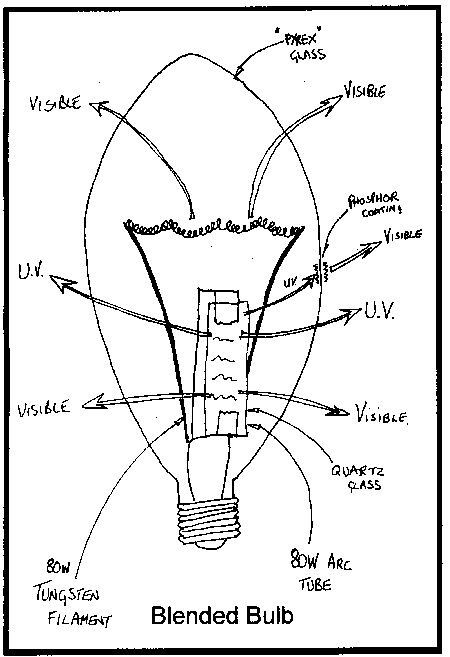
Firstly, the bulbs themselves usually referred to as MV and Blended but
what's the difference? Well, in simple terms, there is no difference.
The MV light contains an arc tube that is made of quartz glass and
filled with argon and it is the electricity travelling through this
that produces the light. The Blended bulb also has an arc tube in it so
produces light in the same way but it also has a tungsten filament as
well. The reason for the extra filament is it enables the bulb to be
used without a costly and cumbersome external choke. The reasons that
the arc tight needs a choke is that when the bulb is first switched on
the mercury inside it is solid and needs to heat up and vaporise before
it will conduct the electricity. While it is heating up the resistance
inside the arc tube is so low that if the choke were not in place a
spark would be produced across the terminals and the bulb would
explode! So the choke acts as an external buffer to prevent too much
electricity flowing through the bulb. The Blended bulb does not need a
choke because it has an internal filament in parallel with the arc tube
that has a lower resistance and therefore conducts most of the
electricity away while the arc heats up and the mercury vaporises. This
explains why the Blended bulbs light immediately, through the tungsten
filament instantly glowing, while the MV bulb is slow to light as the
mercury melts. Once both bulbs have warmed up they are both giving of
the same sort of light via an arc tube. This light is high in UV, which
can be dangerous (There are three types of UV according to their
wavelengths - UV A gives us a sun tan, UV B and UV C are even more
dangerous as they could give us cancer!) and so the arc tube is
surrounded by a barrosilicate glass (trade name Pyrex) sleeve coated in
phosphorus to absorb the UV and convert it into harmless visible light.
However, not all of the UV is filtered out, some still radiates to help
attract the insects. As the outer glass is made of barrosilicate it can
withstand thermal shocks far better than the average sodalime glass and
therefore should cope with light, warm rain however it will have
inevitable internal stress points, especially around the base, which
could lead to cracks if exposed to colder rain. To prevent this many
people place a Pyrex bowl over the bulb if they suspect rain is about.
This is fine and has proved to work well however the extra layer of
thick glass almost certainly removes most of the UV that is being
produced by the bulb, so this may well lower its effectiveness
considerably. If rain is not expected then both types of bulb should be
more effective if left uncovered.
A final point, why is it that the 160-Watt Blended bulb is supposed to
be less effective than the 125-Watt MV bulb? The answer to this lies in
the power of the arc tubes. The Blended bulb contains an 80-Watt arc
tube and an 80-Watt filament while the MV bulb has a 125-Watt arc tube.
So the MV bulb has a more powerful arc tube that outperforms the
blended one.
Genitalia Workshop - Jon Nicholls
On Sunday 18 October a group of people gathered at Orwell High School
to dissect some of the more troublesome species that can only be
differentiated by this method. Having tried in the past to dissect a
male and then been unable to identify what I was looking at I was
sceptical of the usefulness of this technique. Jon Clifton was our
expert, and he demonstrated how to remove and mount the genitalia of a
Copper Underwing. First the abdomen was immersed in a caustic solution
of potassium hydroxide for about twenty minute while being heated with
an upturned 40W light bulb. Then the abdomen, now suitably softened,
was teased apart with a small needle mounted on a matchstick. As all
that is left intact by the potassium hydroxide is the chitinous
genitalia this was easier than you might expect. Once the genitalia
could be seen clearly, with all the soft tissues removed, it was placed
on a slide and immersed in a few drops of mountant. We repeated the
procedure for a possible Svensson's and compared the two. Using the
diagrams in MBGBI it was immediately apparent that the slides were far
easier to interpret than we had all expected and after a brief
discussion we were all happy to agree that the two moths were indeed a
Copper Underwing and a Svensson's Copper Underwing. We then did the
same for a Dark/Grey Dagger and again were able to identify it, using
Skinner, as a Grey Dagger. This turned out to be a very successful
workshop and I would like to thank Jon for his clear and skilful
demonstration, which gave us all the confidence to go away and use this
technique in the future.
Suffolk Moth Survey
Aspal Close. 28 August
Aspal Close is a small nature reserve, situated north of Mildenhall, in
the village of Beck Row. The local Postmistress referred to it as "just
a field" but it has more interest than your average Suffolk field with
some long grass, old trees and scrub. Eight traps were set up around
the woodland and they attracted over sixty species, including; Angle
Shades, Antler, Archer's Dart, Blood-vein, Burnished Brass,
Canary-shouldered Thorn, Centre-barred Sallow, Copper Underwing,
Feathered Gothic, Frosted Orange, Hedge Rustic, Maiden's Blush, Oblique
Striped, Purple Bar, Red Underwing, Straw Underwing, Toadflax Pug,
Vapourer, Yellow Belle and Yellow Shell. Micros included; Orange Swift,
Cydia splendana, Carcina quercana, Platytes cerussella, Evergestis forficalis, Udea lutealis, Pediasia contaminella, Catoptria pinella, Pyrausta cespitalis and Caloptilia alchimiella.
Minsmere. Friday 4 September
Minsmere is well known as one of the RSPB's most popular reserves but
it has great potential as a habitat for moths as well. There are
reedbeds, heathland and woodland, all of which are potential sites for
detailed study unfortunately the wind was a little strong for the more
open habitats and so it was decided to go into a nearby area of
deciduous woodland where six traps were tentatively set up, with the
forecast of heavy showers hanging over us we were all prepared to pack
away at the first sign of rain. Six traps soon became five when we
found over fifty hornets in one of the Skinner traps! The temperatures
were in the high teens for most of the evening, and we did not get any
rain to speak of, so the final count of over seventy species was not
entirely unexpected. The macros included; Angle Shades, Archer's Dart,
Black Arches, Bordered Beauty, Canary-shouldered Thorn, Chevron, Large
Wainscot, Lunar Yellow Underwing, Maiden's Blush, Peacock,
Pinion-streaked Snout, Red Underwing, Ruby Tiger, Southern Wainscot,
Straw Dot, Vapourer, White Point and then three new macros for the
Suffolk Checklist in Dark Spectacle, Webb's Wainscot and Barred
Chestnut. The micros included; Agriphila
geniculea, Agriphila latistria,
Agonopterix arenella, Acleris emargana, Caloptilia alchimiella, Argyresthia goedartella, Tinea semifulvella and Ypsolopha alpella.
Friday Street. Friday 18 September
Friday Street is a small row of houses, down a narrow country lane,
that leads to the north-western edge of Rendlesham Forest. This part of
the forest consists mainly of pine plantation but has a small valley,
created by a stream, lined with some mature deciduous trees. As it is
only a short distance from the oaks of Staverton Park these trees could
be all that remains of a much larger woodland. We set up six traps, in
and around the valley, and waited for the results in temperatures in
the high teens. We eventually found over forty species including;
Autumnal Rustic, Barred Red, Barred Hook-tip, Birch Mocha, Black
Arches, Brown-spot Pinion, Canary-shouldered Thorn, Centre-barred
Sallow, Dark Sword-grass, Deep-brown Dart, Frosted Orange, Latticed
Heath, Lunar Underwing, Lunar Yellow Underwing (again found in numbers
outside the Brecks) Maiden's Blush, Oak Hook-tip, Rosy Rustic, Small
Dusty Wave, Spruce Carpet, Straw Dot and Vapourer. Micros included;
Ypsolopha parenthesella, Platytes alpinella, Olethreutes lacunana,
Apotomis betuletana, Eudonia angustea, Pandemis corylana, Ypsolopha
dentella, Acleris emargana
and Agonopterix alstromeriana.
Shingle Street. Friday 26 September
A warm but clear night greeted us at one of the most desolate parts of
the Suffolk coastline at Shingle Street. We set up four traps around
the first car park and although it felt cold the temperatures were in
the teens throughout the night. Things were predictably slow with a
final count of less than twenty including; Angle Shades, Autumnal
Rustic, Beaded Chestnut, Bright-line Brown-eye, Cabbage, Common
Wainscot, Dark sword-grass, Feathered Brindle, Feathered Ranunculus,
Large Wainscot, Large Yellow Underwing, Latticed Heath, Lunar
Underwing, Setaceous Hebrew Character, Silver Y, Square-spot Rustic,
Agriphila geniculea, Nomophila noctuella and Eudonia angustea.
Rede Wood. Friday 2 October
Rede Wood is situated north of lpswich near Henley. It is only a small
wood but with the potential to produce many species due to its diverse
mix of trees and shrubs. The temperature was into single figures and so
we did not expect many moths but were disappointed when only four
turned up! We got Barred Sallow, Brown-spot Pinion, Dark Sword-grass
and Acleris emargana.
Wolves Wood. Friday 16 October
Wolves Wood is an important RSPB reserve on the outskirts of Hadleigh
which has been visited many times this year. The one moth that we were
hoping to see was the Merveille du Jour and any others still about at
the end of a long season. We saw over a dozen species including; Barred
Sallow, Brick, Centre-barred Sallow, Chevron, Green-brindled Crescent,
Satellite, Winter Moth and yes the Merveille du Jour. As on so many
nights this year Hornets were a problem and several of the moths in the
traps were removed before they could be identified. This trend seems to
have been repeated in traps all over the country, it certainly has been
a very good year for Hornets and Wasps.
Records from recorders around the
county
Location: Beccles Marsh. Recorder: Mr T.W.Fairless
Flying close to the River Waveney, on the Beccles by-pass, nearly
opposite Safeway's was spotted a Clifden Nonpareil. A Chiffchaff came
and had a look at it, followed by a couple of walkers who scared it
off into a nearby oak tree from which it failed to appear.
Location: Dower House and Aldringham Walks. Recorder: Dominic
Funnel!. Jan - April
Dominic has produced another impressive list of species in June and
July with macros that included; Fox, Drinker, Peach Blossom, Common
Lutestring, Blotched Emerald, Satin Wave, Fern Scorched Wing, Peppered,
Engrailed, Barred Red, Grass Wave, Privet Hawk, Pine Hawk, Lime Hawk,
Eyed Hawk, Poplar Hawk, Broad-bordered Bee Hawk, Bedstraw Hawk,
Elephant, Hawk, Small Elephant Hawk, Lobster, Cream-spot Tiger, Clouded
Buff, Heart and Club, Dark Swordgrass, True Lover's Knot, Pearly
Underwing, Purple Clay, White colon, Broom, Campion, Shore Wainscot,
Shark. Sycamore, Miller, Bird's Wing, Bordered Sallow, Cream-bordered
Green Pea. Marbled White Spot, Beautiful Golden Y and Dark Spectacle.
Micros have included; Aethes
francillana, Lozotaenia
forsterana,
Epiblema cynosbatella, Chilo phragmitella, Donacaula mucronellus,
Eudonia pallida, Nymphula nymphaeata, Ostrinia nubilalis, Synaphe
punctalis, Acrobasis
consociella, Oncocera
palumbella, Alipsa angustella
and Phycitodes binaevella.
Location: Eye. Recorder: Paul Kitchener. July / August
Paul notes that he has had 172 species of macros in the past two
months, with his best night being on the 20 July when he had 66
species. Notable ones have included; August Thorn, Bird's Wing, Black
Arches, Buff-tip, Canary-shouldered Thorn. Coxcomb Prominent,
Cream-bordered Green Pea, Drinker, Dusky Sallow, Dusky Thorn, Fern,
Frosted Orange, Garden Tiger, Herald, Leopard, Oak Eggar. Oak
Nycteoline, Olive, Peach Blossom, Pearty Underwing, Red Underwing,
Royal Mantle, Sallow Kitten, Scorched Carpet, Shark, Vapourer, Varied
Coronet and Wormwood. Micros have included; Calamotropha paludella,
Pyrausta aurata, Udea lutealis, Nomophila noctuella, Hypsopygia
costalis, Aglossa pinguinalis,
Galleria mellonella and Oncocera formosa.
Location: Felixstowe. Recorder: Jon Nicholls. June-September
June saw a continuation in the commoner species such as Garden Carpet
and Heart and Dart but also had a fair few new species such as Pebble
Hook-tip, Bird's Wing, Elephant Hawk, Bordered White, Magpie, Scorched
Wing, Miller, Varied Coronet and Buff Arches.
July also had its fair share of new species including; Maple Prominent,
Clepsis spectrana, Udea prunalis, Lozotaeniodes formosanus, Pine
hawk,
Cinnabar, Dark Sword-grass, Lyonetia
clerkella and nurhbers of Croesia
forsskaleana and Evergestis
extimalis.
August had its share of new species such as Dusky Sallow, Pale
Prominent, Vapourer, Ruby Tiger, White Point, Nymphula nymphaeata,
Orthopygia glaucinalis, Rosy
Rustic, Garden Tiger, Drinker, Straw
Underwing, Red Underwing (a lot more common this year?), Old Lady (Also
seen a lot at light this year?), Ypsolopha
scabrella, Feathered
Ranunculus and Lunar Underwing.
September was a good month for the Feathered Ranunculus again and had a
few new species such as Brown-spot Pinion, Small Dusty Wave and Blair's
Shoulder Knot.