‘Biodiversity’ and ‘action plans’ are common buzzwords heard in the
conservation community at the moment but what do they mean to people
interested in moths.
Biodiversity refers to the variety of living things on the planet
including all species of living animals and plants. Biodiversity is
further taken to include the variety of habitats in which living things
exist. Each living thing is of equal importance and lives in
relationship with other living things.
Why does biodiversity matter? This basically boils down to the
importance of biodiversity to our quality of life. Our lives would be
much poorer without the variety of species and habitats that we have
nowadays. We also have a responsibility to future generations to leave
them as rich a natural heritage as possible.
In 1992 at the “Earth Summit” in Rio de Janeiro 150 countries
(including the UK) signed up to an agreement that recognised the
worldwide concern at the current rate at which habitats and species are
being lost. Each country recognised that it had a primary
responsibility for maintaining the biodiversity within its own
boundaries.
The UK government then went on to produce a plan of how it would go
about implementing the “Earth Summit” agreement. This appeared as
"Biodiversity: the UK Action Plan" in 1994. A Steering Group was formed
and produced its report in 1995 which outlined how conservation actions
might be undertaken and included national biodiversity action plans
(BAPs) for an initial 14 habitats and 116 species.
It was realised at an early stage that action plans would need to
implemented at the local level through Local Biodiversity Action Plans
(Local BAPs). "Action for Wildlife in East Anglia" published in 1996
initiated the biodiversity process in Suffolk with the setting up of
the Suffolk Local Biodiversity Action Plan Working Group. This has
representatives from various interested bodies including Suffolk County
Council, English Nature, Suffolk Biological Records and the RSPB. It
will be the responsibility of the Working Group to draw up and to
progress the Local BAPs.
The Working Group has listed those local species and habitats for which
it proposes to develop local action plans to aid in their the
conservation based on the species and habitats listed in the national
action plan. In addition to species listed in the national action plan
list the Working Group has added species which are of ‘local
character’, those viewed as species which occur in the county and have
a high priority for conservation effort, the Dingy Skipper butterfly
being an example.
I became involved in this action planing process as Moth Conservation
Officer for the Suffolk Branch of Butterfly Conservation in the summer
of 1996 and later as joint County Moth Recorder through the Suffolk
Naturalists’ Society . Butterfly Conservation (BC) is the national lead
partner for lepidoptera and produced a list of butterflies and moths
for which action plans were to be written for each of the regions in
the country, our region being East Anglia. The main criteria used for
selection of a species was whether it was a Red Data Book species or
not. After consultation with Arthur Watchman and Mike Hall the list of
East Anglian species was narrowed down to those moths thought to occur
or have recently occurred in Suffolk. For these moth species action
plans were written listing the conservation actions to be carried out.
Unfortunately the list of moth species identified by Butterfly
Conservation does not agree with the list produced by the Suffolk Local
Biodiversity Action Plan Working Group. Following discussions with the
Working Group some moth species (Dotted Footman, Fenn’s Wainscot,
White-mantled Wainscot) from the BC list have been added to their list
but not all. How this discrepancy between the lists produced by the
national lead partner (BC) and the Working Group has arisen I have not
been able to determine. This continuing discrepancy I think is a bit of
a shame as one of the key aspects of the biodiversity initiative is
that all conservation bodies should be working to the same agenda. The
current difference in species lists between the two organisations will
lead to fragmentation of the limited resources and effort that is
available. As an aside, I would question some of the species in the
Working Group’s list as occurring in Suffolk and others whether they
justify prioritising as in need of urgent conservation.
The Suffolk BC action plan lists the following moth species; Ground
Lackey, Tawny Wave, Bright Wave, Pauper Pug, Dotted Footman, Pigmy
Footman, Grey Carpet, Barberry Carpet, White-spotted Pinion, Fenn’s
Wainscot, White-mantled Wainscot, Marbled Clover, Four-spotted, Shaded
Fan-foot and Bordered Gothic.
The Working Group’s action plan list consists of Bright Wave, Marsh
Moth, Coleophora tricolor,
Bordered Gothic, Buttoned Snout, Double
Line, Lunar Yellow Underwing, Barberry Carpet, Pale Shining Brown,
Four-spotted, Square-spotted Clay, Dotted Footman, Fenn’s Wainscot and
White-mantled Wainscot.
One weakness of both lists is that microlepidoptera are poorly
represented at the moment, BC intends in the future to add more
microlepidoptera to the list.
As Moth Conservation Officer for Suffolk BC I shall be trying to
implement the plans as laid out for Butterfly Conservation and working
with the Working Group where the species occurs in both organisations’
action plans.
One of the main actions listed in each of the Suffolk BC action plans
is to do more recording targeted at the species listed. This will
hopefully lead us to a better understanding of the distribution and
abundance of the targeted species. At sites where these species occur
site owners will be informed of the species presence with the probable
advice of maintaining the current habitat through whatever management
scheme is in place. Moth recorders around the county can also help by
providing more information on the distribution and abundance of these
targeted species. With this approach we will hopefully stop or slow any
further decline of these moth species in the county.
Taking the next step by trying to increase the habitats or providing
advice on precise habitat requirements for the targeted species is a
difficult one. I do not think that we have a very good understanding of
moth habitat requirements. People have generally studied butterflies in
more depth than moths and still have problems with re-introductions, so
advising on precise habitat requirements for the targeted moth species
may be beyond our current expertise (or at least mine). This lack of
knowledge will also make it very difficult to extend habitats around
areas where the species exists.
If you are connected to the ‘net’ then further information can be found
at Suffolk County Council’s Suffolk Biodiversity Action Plan web page –
http://www.suffolkcc.gov.uk/countryside/action_plan/main.html
Blossom Underwings in East Anglia -
Tony Prichard
References : NS – Neil Sherman, GB – Graham Bull, TP – Tony Prichard,
EP – Eric Patrick, AW – Arthur Watchman, JW – Jan Watchman, Richard
Stace - RS.
During the early part of April this moth was recorded at a few sites
around southern Suffolk. The last confirmed Suffolk record of this moth
that I am aware of was by Rafe Eley at Nowton in 1948. Morley’s
Lepidoptera of Suffolk only mentions 4 records from the 1800’s up to
1936.
The records started arriving when RS recorded two individuals at Lower
Holbrook on the 3rd April 1999. NS, GB and myself confirmed the
identification the following day. A couple of MV sessions at Little
Blakenham Pits on the 4th April (NS, GB, EP, TP, AW, JW) and at Lower
Hollesley Common (NS, GB, TP, EP, RS) on the 5th April turned up
further singletons and meant that a few more people had sight of this
moth.
Jeff Higgott at Rushmere, Ipswich also reported singletons on the 6th
and 8th April, although an MV session at the Ipswich Golf Course (next
door to Jeff’s garden) on the 9th April failed to turn any records up
despite having 6 MV lights out on the course (NS, GB, TP, EP, RS).
A similar picture appears to have occurred in Norfolk where the moth
has not been recorded since the 1950’s. In Essex where they appear to
have a resident population south of Colchester, the moth was being
recorded in people’s gardens. I have also been informed of it being
recorded at a garden trap in Cambridgeshire.
The moth is not thought to be a migrant which begs the question – where
did these moths come from? Have they been present in the county at a
very low density all this time and have not been recorded previously
because people tend not to do much trapping at this time of year. Have
the moths moved in from another area? The colony south of Colchester
would seem the nearest but this does not explain the similar picture
found in other counties.
I gather from Paul Waring that the species is prone to have population
explosions after long periods of being at very low density, one such
explosion occurred in the 1930’s. It seems to me at the moment that the
best explanation is that it has been present at very low numbers all
the time and there has been a recent upsurge in its abundance. It will
be interesting to see if similar or greater numbers are recorded next
year. I shall also be looking to see if I can beat the larvae from oak
or hawthorn during the period from May to mid-June
If any one has further records for this moth I would be very grateful
if they could send the records in with as much detail as possible;
precise dates and locations recorded along with numbers seen. It would
also be useful to know if a voucher specimen has been retained.
National Moth Night (extract from
Atropos)
In recent years, both the Essex and Sussex Moth Groups have organised a
County Moth Night, in which the catches from moth-traps operated on a
designated night are collated and a summary produced in the groups’
newsletter. With the new millenium fast approaching, it seemed a good
idea to organise a national event. With the help of InsectLine and
Brian goodey of the Essex Moth Group, we are please to launch National
Moth Night 1999.
The aims of this event are as follows:
To encourage widespread moth recording and to gather useful data.
To stimulate wider interest in moths and raise their profile
amongst the public
To raise funds for moth conservation projects.
We would like as many people as possible to run light-traps in as many
different area as possible on the night of Saturday 17 July 1999 (i.e.
the period between dusk on Saturday night and dawn on Sunday morning).
Participants may choose to record the moths in their garden or their
local patch, but we would encourage people to visit new areas that they
have not looked at previously, or for a number of years. That area
you’ve often thought about visiting but never got round to it – go
there on National Moth Night! Visits to under-recorded/remote areas are
also encouraged. However, do ensure that you have the permission from
the appropriate landowner.
Participants should send the following information to Brian Goodey, 298
Ipswich Road, Colchester, Essex, CO4 4ET. Brian will be collating the
information; all records should reach him by 17 August 1999.
Recorder’s name(s)
Site name and six-figure grid reference
Local weather conditions
Brief habitat description
Number and type of MV traps used (and details of any other
recording techniques employed)
How long the traps were operated
A full list of species identified, the ten most abundant
macro-moth species listed in chronological order. (i.e. the most common
first, least common last). It would be useful if recorders drew
attention to records of significant county interest.
Numbers of common, scarce and rare migrants encountered. In
particular we would like totals of Diamond-back Moth Plutella
xylostella, Rusty-dot Pearl Udea
ferrugalis, Rush Veneer
Nomophila
noctuella, Dark Sword-grass Agrotis
ipsilon, Pearly Underwing Peridroma
saucia and Silver Y Autographa
gamma.
PLEASE DO NOT SEND RECORDS TO THE ATROPOS EDITORIAL ADDRESS.
Brian will be forwarding information to the relevant county recorder. A
full account of the event will appear in the January 2000 issue of
Atropos. We would be pleased to hear of any unusual incidents and
details of any unusual creatures attracted to the moth-trap.
Three prizes will be awarded in the following categories:
Record of greatest conservation value (Macrolepidoptera).
This may be a species not recorded locally for some time, or a scarce
species at a new site. The winner will receive a professionally made
Skinner MV trap complete with electrics donated by Anglian
Lepidopterist Supplies (worth £80)
Rarest migrant species recorded
InsectLine will award the winner a £50 book token which can be
used to purchase titles from the Atropos Bookshop (valid for two years).
Most unusual location trapped at
A two-year subscription to Atropos will be awarded to the winner in
this category.
Please note that the following rules apply:
Photographic proof will be required in all 3 categories. In the
case of category 3 a photograph is required of the trap(s) set up on
the site prior to dusk, or the following morning. All photographs
should be sent to the Atropos editorial address (see inside front
cover) and may be published in Atropos.
In order to qualify for category 2, full details of capture (and
name of the captor) must be left on the InsectLine hotline (01565
722928) the next day. If verification is required, a message should be
left to that effect.
Members of the Atropos editorial panel or the InsectLine team are
not eligible for prizes.
All decisions made will be final.
Regular updates on the event will be broadcast on the National Moth
Night Information Line (0891 446862 – note that calls cost 60p/ per
minute). The proceeds will be donated to moth conservation projects.
Another important aim of the event is to stimulate wider interest in
moths amongst the public. We hope that nature reserves / country parks,
moth groups and conservation organisations will organise local
events that are open to the public. Events can be promoted on the
National Moth Night Information Line by telephoning the InsectLine
Hotline (01565 722928 – normal rates apply), leaving basic details and
a contact telephone number.
It is hoped that this will become an annual event. 1999 is very much a
trial year and no doubt refinements will be made in future years.
Above all, have a good night!
Mark Tunmore
Request for information on Riband
Wave forms - Tony Prichard
I recently received a request from Roy Leverton to provide him with
information about the ratio of the normal banded form of the Riband
Wave (Idaea aversata) to the
plain ab. remutata form. Roy
explained that various literary sources give conflicting data on the
ratio and that there seems to be a regional variation in the ratio
although this is not really documented.
As far as I am aware the ratio between the two forms has not been
investigated in Suffolk (both forms do occur in the county) so I have
not been able to respond to his request. However, it would be useful if
recorders could keep a record of the ratio of the various forms that
occur during the forthcoming year. The information can then be fed back
to Roy at a later date as well as publishing the results in the SMG
newsletter.
Alternatively if somebody already has this information then I would be
very interested to hear from them.
Moths to look out for in Suffolk in
1999 - Neil Sherman
The following species of moth were recorded in small numbers within the
county in 1998 and could be found in many other sites this year. The
first three could possibly be expanding their range, whilst the others
have possibly been overlooked as they are difficult to find as adults,
but are much easier to record as larvae. All records of these moths
(with as much detail as possible) would be gratefully accepted by the
county moth recorders, to monitor these particular species' fortunes.
Species which expanded their range in 1998
Least Carpet
Recorded frequently in the Felixstowe area, and seemingly established
there, this distinctive little wave was noted in the Ipswich area in
1998 (NS/SN- Ipswich Golf Club, JH - Rushmere, TP - Ipswich) and has
also been noted along the coast in the past (SD - Levington 1994, CA -
Minsmere 1995, JC - Aldeburgh 1996). It could continue its northward
spread in 1999 - watch out for it anywhere its larval foodplant, ivy
and clematis grow (gardens are an ideal habitat).
Orange Footman
This footman flies before any other (in late May and June) and is
therefore readily identifiable. It was found in Woodbridge in 1996
(RK), Minsmere in 1995 (CA), Lower Hollesley Common in 1996 (SMG) and
three more locations in 1998; Lineage Wood (SBC), Hollesley Common(??)
and Ipswich Golf Club (SMG). It could turn up at other woodland or
heathland sites with mature oaks - the larvae feeding on lichens
present on the bark.
Lunar Yellow Underwing
This was recorded from many sites on the Sandlings belt (Friday Street,
Ipswich Golf Club, Rushmere, Minsmere (SMG)) and elsewhere (Burgh
Churchyard (NS), Cavenham Heath (Coleman)) in 1998. The moth was much
more widespread in the past but has been restricted to the Brecks in
recent years. These sightings outside the Brecks may indicate that it
is recolonising its lost distribution.
It is very similar to the Lesser Yellow Underwing, but can be told by
its smaller size and the presence of a well defined black mark in the
top corner of the forewing. It could also be confused with the Large
Yellow Underwing which is much bigger and lacks the 'lunar' mark on the
hindwing.
It flies during August and September and could in theory be found on
any grass/heather areas, the larvae preferring fine-leaved grasses.
Species easier to find as larvae
Yarrow Pug
Larvae of this pug can be found, sometimes in numbers, by searching the
seed heads of Yarrow plants from late August to October. They are
cryptically coloured, being brown with darker brown chevrons down the
back. They can be reared on the Yarrow stems, the moth hatching out the
following summer. So far, these larvae have been found on several sites
around south Suffolk (TP) and could be found elsewhere, Yarrow being a
common and widespread plant in the county.
Broad-bordered Bee Hawk-moth
The larvae of this moth and its distinctive feeding signs have been
recorded at several sites across the county, predominantly in the south
and east (NS, TP). Any patches of sprawling honeysuckle growing in
sunlit areas of woodland, heathland or forestry sites are ideal for
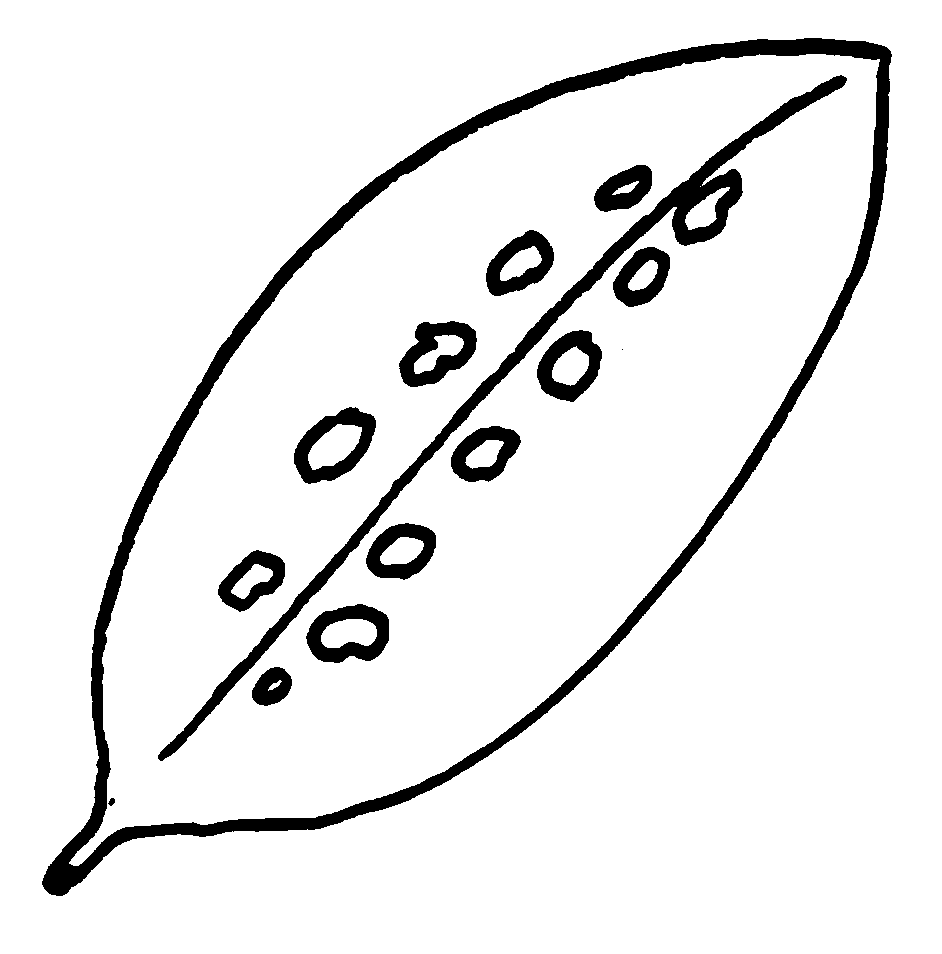
them. Any leaves on the honeysuckle plants which show small round holes
nibbled out in rows along the midrib (see diagram) are caused by the
young larvae. If the eaten edges of the hole are not brown and
extruding sap, turning the lead over could reveal the caterpillar,
which is green in colour with a distinctive dark horn at the end. When
the larva is larger, they consume the whole of the honeysuckle leaf so
their feeding signs are not so readily apparent, making the larvae much
harder to find.
Fig 1. Leaf of honeysuckle showing damage
caused by Bee Hawk-moth
caterpillar
Lunar Hornet Clearwing
Feeding signs of this moth have been found at several widespread sites
during the winter months, whilst undertaking coppicing or scrub
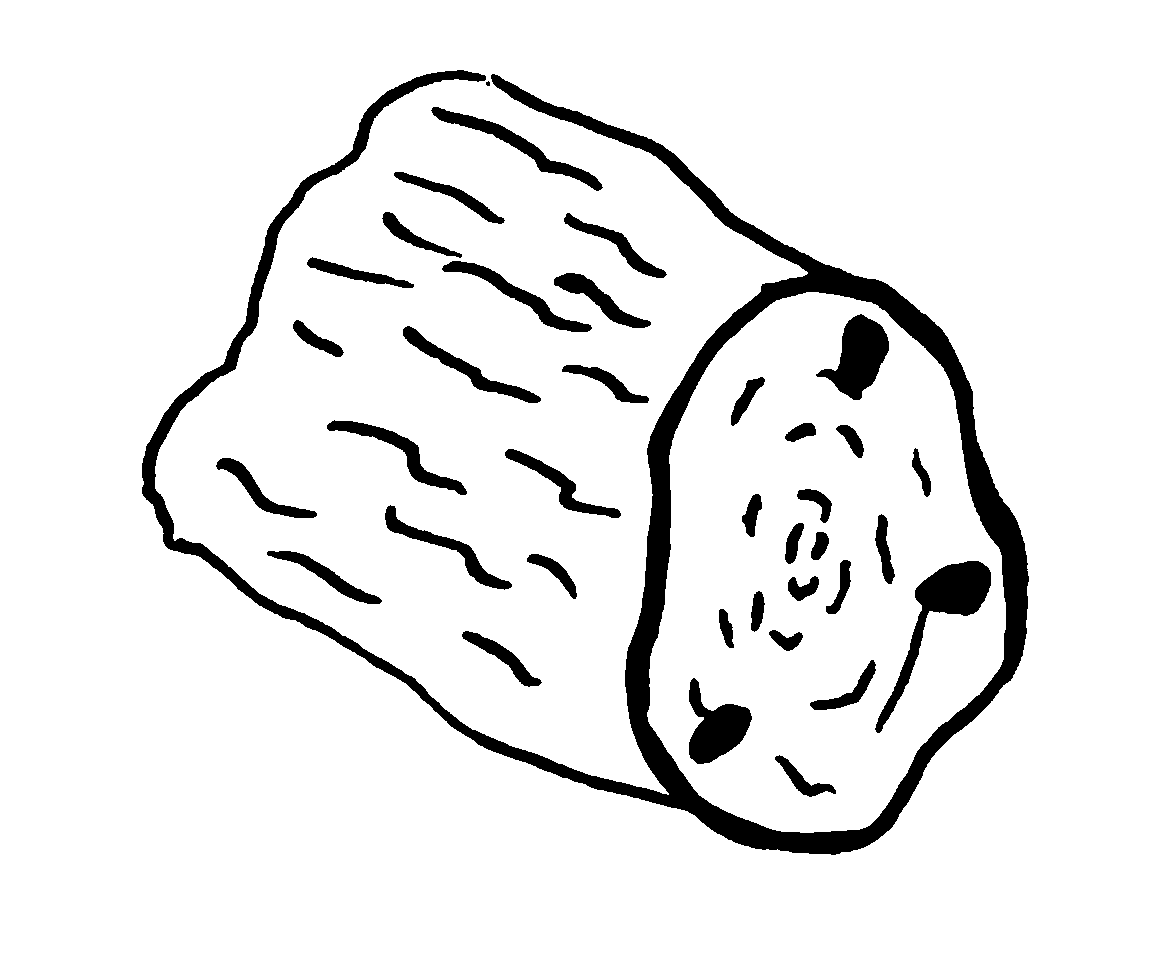
clearance of sallow and willow trees. Cut stumps more than 10 cm in
diameter can be searched for the borings of the mature caterpillars.
Their tunnels are approximately 1 cm in diameter, 0.5 - 1 cm in from
the bark. If larvae are present in the cut log section (they are
25-30mm long, white with a chestnut brown head) they can be reared to
the adult stage by placing the stump in a tray of damp sand and left
undisturbed, producing moths in June/July.
Fig 2. Cut sallow log showing the
position of Lunar Hornet Clearwing tunnels
The Suffolk Moth Panel and
Submitting Suffolk Moth Records - Tony Prichard
At a recent meeting of the Suffolk Moth Group it was agreed to form the
Suffolk Moth Panel (SMP) to validate records received from recorders
from around the county. The panel's purpose will be to validate and
accept/query records that are received by the County Moth Recorders.
The intention behind the formation of the panel is to ensure that the
Suffolk moth records we hold can be trusted as a reliable source of
information. The County Moth Recorders have agreed to delegate
responsibility for the validation of records to the panel. It is
intended that in the normal run of things the panel will meet once a
year (in January or February) to validate records received over the
previous year. The members of the panel do not presume to be experts in
all moth matters and will consult people outside the panel for
expertise and comments where required.
At the moment, even with the 1997 Suffolk Moth Checklist there is a
degree of uncertainty about which records may be queried when submitted
and how much information we would like to receive about various
species. To try to clarify the situation we are categorising the moths
into 4 main categories so that recorders will know the minimum amount
of information we would like to receive for particular species
when they submit their records. Hopefully, this will mean that the
appropriate information can be captured at the time the moth is
recorded and this information can then be submitted to the county moth
recorders.
The greater detail of recording should make the validation process of
the SMP easier and will help give us a better understanding of the
moths in Suffolk. The extra information will also help us to monitor
localised and rare species for signs of decline or increase.
Following these guidelines may mean that preparing records for
submission to the recorders may take some more time than previously.
However, if you do not feel that you have the time to follow the
guidelines then please continue to submit records as you currently do.
We would rather have abbreviated records than no records at all.
Alternatively if you wish to submit detailed records for all your moth
recording then feel free to do so.
It is intended that when the next issue of the Suffolk Checklist is
distributed it will contain details of which category each moth species
falls into. Thus by referring to the checklist recorders should know
how much information we would like about a species and whether the
record is likely to be queried.
The following outlines the categories that have been set up with some
explanation of the category. Categories 1 and 2 will normally be
accepted without validation by the SMP, categories 3 and 4 will be
vetted by the SMP at their annual meeting.
Categories of Moths for Recording Purposes
Category 1
This category includes macro-moths that are widespread and abundant,
are readily identifiable and already on the Suffolk Checklist. This
category also includes common micro-moths that are also on the Suffolk
Checklist. Annual records should suffice (eg recorded in 1998).
Examples include Large Yellow Underwing, Heart and Dart, Light Emerald
and Common Carpet.
Category 2
This category includes macro-moths which although they may be readily
identified and already be on the Suffolk Checklist are of restricted
distribution or occurrence so we would like to collect as much
information about them as possible.We would like to know precise dates
(or at least a range of dates), numbers recorded and who determined the
species. This category also includes all but the most common of
migrants. Examples include Gem, Small Brindled Beauty, Olive and
Nut-tree Tussock.
Category 3
This category covers moths which are not readily identifiable and may
be confused with other species. It also includes species that are on
the Suffolk Checklist but are scarce enough for us to want to monitor
the records that we receive. This notably includes rare moths which may
be easily confused with commoner species (eg Water Ermine being
confused with White Ermine). Records of some of these species will need
to indicate that the genitalia has been examined (eg Dark Dagger to
distinguish from Grey Dagger). This category also includes all those
micro-moths on the Suffolk Checklist which are not listed in Category
1. As with Category 2 we would like to receive records as detailed as
you can possibly supply for these species as this may help the SMP in
the process of validation. Examples include Ground Lackey, Pale
November Moth, Alder Kitten, White-mantled Wanscot and Shaded Fan-foot.
Category 4
This category covers all moths which are not on the current Suffolk
Checklist plus a few on the Checklist for which we have only a single
or a few records. The species may be hard or easy to identify,
localised or rare. Voucher specimens (preferred), photographs or
detailed descriptions with identification features noted will be
required for the acceptance of these records. As with Category 2 and 3
we would like to receive detailed records for these species. Examples
of species already on the Suffolk Checklist in this category
include Double Line, Oak Processionary and Blair's Mocha.
Moths on the Web - Tony Prichard
If you are connected to the internet then you may be interested in a
web site that I have set up - ‘Suffolk Moths’. This
contains various information about mothing and moths in Suffolk. It
also hosts the home page for the Suffolk Moth Group with information
about the moth group. The site is still in its infancy but hopefully
will grow with time.
The URLs are http://www.btinternet.com/~Tony.Prichard for the Suffolk
Moths home page and http://www.btinternet.com/~Tony.Prichard/Smg for
the Suffolk Moth Group home page.
The Norfolk Moth Survey also have a web site at the following URL
http://www.paston.co.uk/users/ncm/moth.html. Their site contains some
interesting articles, copies of their newsletters and recent news.
The following is a list of some other lepidoptera-related web sites
that I have found interesting to visit.
UK Moths http://www.geocities.com/RainForest/Canopy/6658/
This site contains quite an extensive collection of pictures of British
macrolepidoptera, which is continually being updated. Well worth a
visit.
BENHS http://www.benhs.org.uk/
BENHS’s home page, giving details of the society, including
publications, meeting and membership details
IRENe (Ipswich and Region Environmental Network)
http://www.irene.org.uk/
A site acting as host for local groups interested in environmental
improvement.
Butterflies and Moths in Kent
http://www.users.globalnet.co.uk/~kenelks/butterfly.htm
Information about moths and butterflies in Kent, including recent
sightings.
These are just a few there are plenty more to be discovered.
Records
from recorders around the county
(Please note that the records listed here have not necessarily
been confirmed by the Suffolk Moth Panel - TP)
Location: Eye. Recorder: Paul Kitchener.
January-March.
Paul reports that he has had a number of notable moths so far this year
including; Small Eggar, Red-green Carpet and larger numbers of Common
Quakers and Hebrew Characters than last year. On the other hand the
Early Moth has been noticeable by its absence. Others have in cluded
March, Pale Brindled Beauty, Dotted Border, Satellite, Oak Beauty, Pine
Beauty, Early Thorn and Pale Mottled Willow.
Location: Monks Eleigh. Recorder: Arthur
Watchman. Jan-March.
Moths recorded at Onchan, Monks Eleigh during the first three months of
1999. The first moths noticed were three mottled Umbers, attracted to
light on 4 January. Each was of a different form. The following night a
Winter Moth was seen. No more moths were noted until 16 when a Pale
Brindled Beauty appeared. For the rest of the month this species was
the only one recorded except for an Early Moth on 28 and an Alucita hexadactyla which was found
indoors on the last day of the month.
The first March Moths were noted on the 3rd February and are still
appearing at light at the time of writing (6 April). The next day an
Oak Beauty and Hebrew Character were attracted but both these species
became more in evidence in March.
Only single specimens of Spring Usher (17 February), Satellite (18
February), Lead-coloured Drab (15 March) and Chestnut (16 March) have
been recorded during this period. This also applies to that enigmatic
moth the Herald (12 March) which is likely to turn up in any month of
the year. The Satellite and Chestnut are two of the handful of British
macros which overwinter as adults.
The Clouded Drab duly appeared, the first on 12 March, and has since
been seen in a number of its many forms. Other macros noted included
Dotted Border, Early Grey, Red Chestnut, Shoulder Stripe, Early Thorn
and the three Quakers, Common, Small and Twin-spotted. Unlike some
British lepidoptera the Common Quaker seems to live up to its name!
A number of specimens of the micros genus Agonopterix, the members of which
overwinter in the adult form, have been recorded but only one species,
heracliana has been positively identified. Let us hope that volume 4 of
The Moths and Butterflies of Great Britain and Ireland will alter this
situation!
The largest Ypsolophid, Ypsolopha
mucronella was seen on 16 March and Endrosis sarcitrella was found in
the house on 20 March.
Location: St Olaves. Recorder: John
Crouch. Jan-March.
John lives in an area of mixed habitats right on the Suffolk Norfolk
border near to Lowestoft and records a wide veriety of moths. So far
this year he has had; Figure of Eighty, Shoulder Stripe, Spruce Corpet,
Rivulet, Oak-tree Pug, Peacock, Scorched Wing, Early Thorn, Peppered,
Spring Usher, Waved Umber, Pale Oak Beauty, White-pinion Spotted, Lime
Hawk, Poplar Hawk, Elephant Hawk, Buff-tip, Lobster, Iron Prominent,
Lesser Swallow Prominent, Pale Tussock, Least Block Arches, Bordered
Gothic, Dog's Tooth, Pine Beauty, Satellite, Reed Dagger, Bird's Wing,
Oak Nycteoline and Poplar Kitten.
Location: Eye. Recorder : Paul Kitchener.
April-May.
Paul reports large numbers of macro species, many turning up earlier
than recorded in previous years. His best night so far has been 27 May
with 62 moths of 34 species. Hi9hlights include: Chamomile Shark,
Chocolate-tip, Coxcomb Prominent, Eyed Hawk, Figure of Eighty, Frosted
Green, Lesser Swallow Prominent. Lunar Marbled Brown, Maiden's Blush,
Mullein, Pale Oak Beauty, Poplar Hawk, Powdered Quaker, Privet Hawk,
Puss, Scarce Tissue, Silver Y, Spruce Carpet, Streamer, Swallow
Prominent, Sycamore, and Yellow-barred Brindle. Micros have included: Crambus lathoniellus (always the
first of the grass veneers to appear) Aphomia
sociella, Oncocera formosa,
Plutella xylostella and Cacoecimorpha pronubana.
Location : Ipswich Golf Club. Recorder:
Neil Sherman. Jan - May.
Only one moth was recorded in January, this being a Pale Brindled
Beauty.
Trapping in February brought in ten species, including several
overwintering out on their spring flight: the Grey Shoulder Knot and Agonopterix hieracliana (new Site
record), the first of the early season Quakers also appeared along with
the Pine Beauty.
March was a much better month, with twenty-one species (particularly
the Small Quaker and Oak Beauty), several Yellow Horned, Early Grey and
the first Red Chestnut. Micros noted were: Diurnea fagella, Tortricodes alternella, Alucita hexadactyla and Caloptilia betulicola (first noted
in autumn 1998)
The first two weeks of April had some mild nights which produced some
good catches. Three new macros for the site were seen in this period:
Early Tooth striped, Scarce Tissue and Brindled Beauty. Other notable
moths recorded were: Red Chestnut (more common in 1999?), Frosted
Green, Lunar Marbled Brown (abundant), Water Carpet and Great
Prominent. Micros seen were: Eriocrania
subpurpurella (very common), Alucita
hexadactyla and Diurnea
fagella.
Colder weather in the second half of the month reduced moth numbers,
but several more species appeared including Grey Birch, Least Black
Arches, more Brindled Beauties, Purple Thorn and good numbers of Great
Prominent. During sunny days during the last days of April visits to
the heathland areas on the heather resulted in the discovery of the
larvae of two new micro moths for the Site, both Coleophorids: Coleophora juncicolella and C. pyrrhulipennella.
The number and type of moths recorded in May increased rapidly as the
month progressed - 66 macros were noted, with three more new species:
Buttoned Snout, Tawny Pinion and Clouded Bordered Brindle. Other
interesting finds have been: Alder , Bird's Wing, Brindled White Spot,
Dingy Shell, Grey Birch, Lime Hawk, Poplar Hawk, Small Elephant Hawk
(the first time the species have been found), Marbled Brown, Green
Carpet (abundant), May Highflyer, Miller, Maidens Blush (common),
Narrow-winged Pug, Seraphim, Small White Wave, Waved Umber,
White-pinion Spotted, Yellow Belle and Orange Footman (a total of
seventeen have been caught during the month - two were recorded in 1998
and were the first for the Site). Micros have also begun to increase -
the first Pyralids being Scoparia
ambigualis, Evergestis
forficalis and Platytes
cerusella. Other notable species seen were: Cochylis atricapitana, Swammerdamia caesiella, Argyresthia conjugella and the
colourful Eulia ministrana.
Suffolk Moth Survey
Raydon - 7th May 1999
Torrential rain greeted us at the start of the Had leigh Railway Walk
and so it was decided, somewhat reluctantly, to call of the first moth
night of the season.
Bromeswell Green - 8th May 1999
This SWT reserve offers a variety of habitats including mainly marshy,
lowland grassland with some broad-leaved woodland, scrub and saltmarsh.
On this night we ran four MV lights in the scrub and woodland around
the wet meadow on the east side of the road. The weather was quite
warm, although there was quite a strong wind blowing which we tried to
avoid when positioning the lights. Before we turned the lights on we
spent some time beating for larvae and turned up a Capper Underwing
larve on willow and a Dingy Footman larve from blackthorn.
In all we recorded 45 species, of which the more interesting included;
Lime Hawk-moth, Great Prominent, Iron Prominent, Sandy Carpet, Marbled
Brown, White Ermine, Pale Oak Beauty, Caloptilia alchimiella, Pseudoswammerdamia combinella and Pseudorgyrotoza conwagana
Frostenden - 14th May
White Hause Farm covers a large area of mixed habitats around the
village of Frostenden, in North East Suffolk For the evening, we
decided to explore the wet meadows and surrounding woodland. Due to
rain during the day conditions were not good and the night was clear,
cold and very damp. Our first sight was of a Barn Owl quartering over
the meadows. Settling around the lights. the moths trickled in small
numbers and included; May Highflyer, Great Prominent, Dwarf Pug, Lime
Hawk, Waved Umber, Coxcomb Prominent, Rivulet and the beautiful Peach
Blossom. Micros were few and far between, with Epinotia immundana and Esperia sulphurella the only ones
recorded.
Pashford Poors Fen - 21st May
Pashford Poors is one of the last remaining fragments of Fenland on the
edge of the Brecks. Just outside Lakenheath, it boasts a mixture of wet
grassland, woods and dry heathland areas. Six lights were set up at
various locations around the site, and despite the clear, windy
conditions it remained mild with temperatures of 10°C plus, and
around sixty species were recorded.
Wetland moths seen included Dog's Tooth, Yellow-barred Brindle, Figure
of Eighty, Seraphim and Peacock. Breckland speciolities were the
localised Grey Carpet (in good numbers), Crambus lathoniellus, Thisanotia chrysonuchella, Cream
Spot Tiger, Yellow Belle and Evergestis
extimalis. We also saw Clouded Bordered Brindle and another
localised math the Buttoned Snout.
Newton Green - 28th May
(This is an account by TP for the night and not the original write-up
which appeared in the newsletter).
This site was chosen for a moth night as it is the last remaining
remnant of heathland in the west of the county. Unfortunately on
looking over the site there is now very little of the heathland habitat
left on the golf course.
A cold, clear night with poor habitat produced reasonably poor results.
Most notable species recorded was the Small Elephant Hawk-moth, which
turned up at a Skinner trap positioned in the area of the remaining
heathland. At least one heathland species is holding on in the
area! Other species recorded included Buff Arches, Pale
Prominent, Purple Bar, Iron Prominent, Rustic Shoulder-knot and Small
Square-spot. 33 species were recorded in all.