When we find a moth in the trap that we don’t instantly recognise, most
of us reach for Skinner and trawl through the plates until we find it.
If it is not a macro then the appropriate micro book, perhaps Goater,
is used instead. Once you have chosen the correct book to use, then
this method usually works fairly quickly. It can however take a long
time if the moth is one of those awkward ones that doesn’t seem to
match any of the plates. Also some of the specimens found in Skinner
and Goater are not as representative of the variability of many moths
as they could be.
Another problem can be if you are looking in the wrong book! I recently
caught a Pyralid that I had never seen before, it had the
characteristic "pen nib" shape of a pyralid and a white hook mark on
its wings. After several passes through Goater it became clear that it
was not there, however, I then remembered the few smaller Noctuids that
were to be found at the back of Skinner. On looking at plate 42 the
identification soon became apparent and my pyralid turned out to be a
Pinion-streaked Snout. Had I not remembered the smaller Snouts at the
back of Skinner I could have spent a long time looking. Another example
is the Oak Nycteoline, although it is far more common it often fools
the inexperienced beginner ( you know who I mean?).
An alternative option to using the ‘search through the pictures’ method
is to use a key. For many branches of entomology this is the standard
method used, Hoverflies and Beetles can only be identified, by all but
the experts, by using keys. What keys are available for Lepidopterists?
The first key to try is probably ‘Meyrick, (1928) A revised Handbook of
British Lepidoptera‘. This is an un-illustrated book that has been
reprinted by Classey but, as names have changed since it was first
published, it needs to be used with a check list such as Kloet and
Hinks, and also any new moths to Britain since 1928 will not be there.
A more recent key is the one in ‘The Moths and Butterflies of Great
Britain and Ireland’ (MBGBI).
The first place to go is page 150 in volume one, where a simple key to
the suborders of British Lepidoptera sorts out the moth into one of
four groups:
The Zeugloptera have similar shaped hindwings less than 15mm long
with twelve veins reaching the margin, five segmented palpi and no
spurs on the mid tibia. In Britain there are only five examples of
these moths in one family called the Micropterigidae.
The Dacnonypha have similar shaped hindwings less than 15mm long
with twelve veins reaching the margin, five segmented palpi and at
least one spur on the mid tibia. In Britain there are only eight
species all members of the family Eriocraniidae.
The Monotrysia have dissimilar wings with less than twelve veins
reaching the margin and a wingspan of less than 25mm. This consists of
six families in Britain, five micros-Tischeriidae, Opostegidae,
Nepticulidae, Heliozelidae, Incurvariidae and one macro-Hepialidae.
The Ditrysia have dissimilar wings with less than twelve veins
reaching the margin, and more complex genitalia. This group consists of
all the other micro and macro groups.
If the moth is a macro (but not one of the Swifts) then the next key is
on page 64 of volume two. Here fifty five families are represented in
this suborder in Britain. The key consists of eighty three couplets
which define features as simple as having clubbed antennae or white
wings to the more obscure ones such as the bristles on the labial palps
or the vein patterning on the wings. However, don’t despair, like all
keys you soon become familiar with most of the features and learn a lot
about the structure of the moths on the way. This is one of the most
rewarding aspects of using keys as you start to become more familiar
with the key features and learn more about the morphology as your
confidence grows. Using the key to identify moths that you already know
makes the process of interpreting the couplets easier until you need to
identify an unknown.
I used this key with the Pinion-streaked Snout and after fifteen
questions was directed to the Noctuid key on page 125 of volume nine.
The Noctuidae consist of fourteen subfamilies containing over four
hundred species in Britain. Many of the couplets are now more straight
forward such as whether the eyes are hairy or the forewings green but a
few questions refer to the wing venation. This can only be seen with a
microscope, after the wing is soaked in alcohol (or xylene), so you do
need the right equipment to be sure of identification at this point.
Once the correct subfamily, in my case the Hypeninae, has been reached a
fairly simple key leads to the species level.
Like all keys the learning curve is steep and full of many dead ends at
first but with practice it is possible to use this method to identify
most species in Britain. You do not need to go through all the keys
either as you may be able to tell which family it is in from the
initial "jizz" and go straight to the appropriate key. It can be most
helpful when dealing with a totally unknown such as a migrant where
even the family is not clear or one of the more awkward groups like the
Wainscots. The keys will then guide you to the family and possibly the
correct genus but if it is a new species to Britain then this will soon
become apparent.
Perhaps the most important thing about using the keys is not
identification at all but understanding. The keys are based on the
phylogenetic differences between Lepidoptera and by using them these
morphological features that have changed as the lepidoptera evolved
become clear. Thus by using the keys you start to become aware of the
reasons behind the classification system and this can only help to make
the two thousand five hundred and so many British lepidoptera a
little less overwhelming.
Suffolk Moth Group Events, June - September
1999 - Neil Sherman
Combs Wood - 4th June 1999
Due to heavy rain over Stowmarket, we decided to abandon this site in
favour of Bromeswell Green, where it was dry all evening.
The lights were positioned in the mixed habitats of wet meadows, willow
carr and woodland and with broken cloud cover with little wind, we
trapped 72 species of whic 60 were macros.
Interesting moths included; White-spotted Pug, Cream-bordered Green
Pea, the impressive furry Puss Moth (all wetland species), Cream-spot
Tiger, Satin Wave, Bird's Wing, the uncommon White Colon (all heathland
species) and several Brindled White-spots, which have appeared at a
number of sites this season. Micros seen were :- Argyresthia spinosella, Platytes cerussella and the migrant
Plutella xylostella
(Diamond-backed).
Dodnash Wood - 18th June 1999
Dodnash Wood, a privately-owned wood, is one of a group of ancient
woodlands to the south of Ipswich. A mixture of old trees (mainly
oaks), coppiced hazel and sweet chestnut, small pine plantations and an
extensive network of grass rides promised a good number of moths, and
we were not disappointed. 102 species were recorded (85 macros).
Species of note included :- Golf Swift (3 males netted whilst 'lekking'
over bracken), Broom-tip (an uncommon heath-edge species), Small White
Wave (larvae feeding on the hazel coppice present), Small Yelow Wave,
Purple Clay, Brindled White-spot (again in good numbers), Poplar
Lutestring, Blotched Emerald, Barred Yellow, Foxglove Pug, the
beautiful Scallop Shell, Small Clouded Brindle, Dwarf Pug, Tawny-barred
Angle (both pine feeders), 5 species of hawk-moth (Poplar, Privet,
Pine, Elephant and the stunning Eyed Hawk-moth) and most interestingly
the True Lover's Knot (where did this heather feeder come from with
none in the apparent vicinity). Micros seen included :- Argyresthia conjugella, (larvae
feed on rowan which is numerous at this site), Teleoides luculella and Crambus lathoniellus.
Hollesley Common - 25th June 1999
On a cool, clear moonlit night, we set our lights on the mixed gorse,
heather, birch-wood and bracken habitats of this fragment of the once
more extensive Sandlings heaths. Prospects did not seem good, but we
still caught 56 species (47 were macros). Heathland species seen were
:- True Lover's Knot (one of the commonest species of the night),
Broom-tip, Grass Wave (one of this uncommon heather feeding species was
trapped), Cream-spot Tiger, Broom, Narrow-winged Pug, Pine Hawk-moth,
Satin Wave and Clouded Buff. Other interesting moths were Marbled Brown
(in good numbers) and very unusually a Water Ermine!
A few micros were seen, the only ones of note being; Scoparia
pyralella, Pempelia palumbella, Platytes cerussella.
Cutler's Wood - 2nd July 1999
Another visit to an ancient woodland south of Ipswich, to search for
the Shaded Fan-foot, which has been noted in previous years in north
Essex and east of the town (at Bridge Wood and Ipswich Golf Club), this
site being in between the two areas.
A warm humid night with an occasional shower produced a good number of
moths (110 species of which 76 species were macros). The Shaded
Fan-foot duly appeared in good numbers, along with :- Festoon (also in
very good numbers), Common Lutestring, Poplar Lutestring, Small White
Wave (pletny of hazel coppice in the vicinity), Gold Swift, Broom-tip
(feeding the ride edge broom plants), Short-cloaked Moth, the very
hairy Lobster moth, Large Emerald, Blotched Emerald and the Double Dart.
Micros seens included :- Platytes
cerussella, Aleimma
loeflingiana, Yponomeuta
evonymella, Epagoge grotiana,
Epinotia ramella, and Ypsolopha parenthesella.
West Stow County Park - 16th July 1999
On a warm, clear but moonless night we placed 10 moth lights in the two
main habitats in this site - the river valley with its associated wet
grassland and willow trees, and the fragments of Breck grassland with
its special flora. Large numbers of moths appeared as soon as the
lights were switched on (along with clouds of midges and caddisflies)
and were still coming in when they were switched off in the early hours
of the morning. Over 160 species recorded (of which 122 were macros).
Breckland moths seen were :- Dark Umber, Slender Brindle, Marbled
White-spot, Nut-tree Tussock, Pine Hawk-moth, Birch Mocha, Small
Elephant Hawk-moth, Suspected, Four-dotted Footman, Lunar Yellow
Underwing, Broom-tip, Ochreous Pug and Grass Emerald. Along the river
moths seen included; Sallow Kitten, Round-winged Muslin, Dingy Shears,
Lesser Cream Wave, Double Lobed, Cream-bordered Green Pea, Poplar
Hawk-moth (including 7 in one trap), Blackneck and the colourful
Purple-bordered Gold. There were numerous micros, of which the most
interesting were; Numonia suavella,
Hedya salicella, Epinotia brunnichana, Platytes alpinella, Pediasia contaminella, Sitochroa palealis, Calamatropha paludella, Anania verbascalis, Ethmia dodecea and Epiblema foenella.
Thelnetham Fen - 6th August 1999
One of the last remaining fragments of valley fen beside the River
Waveney, Thelnetham boasts a mixture of wet grassland, sedge reedbed
and wet woodland habitat.
After a visit to both parts of the fen, it was decided that Old Fen
would be better, as the other piece had recently been mown for hay!
Six lights were put out on a mild but clear night, and we caught one
hundred species (with 80 macros). Pick of the bunch was the Silver
Hook, a new moth for many people present, which is known to frequent
this area of north Suffolk. This species has previously been recorded
at the site in 1990 by Mike Hall. Other good fen species seen were;
Poplar Lutestring, Dusky Thorn (from the abundant ash trees nearby),
Southern Wainscot, Reed Dagger, Crescent, Bulrush Wainscot,
Brown-veined Wainscot, Small Rufous (recorded in 1998 at nearby Market
Weston Fen also), Fen Wainscot and Cream-bordered Green Pea (another
site for this species, which seems to be quite widespread in the county
despite its notable status), Also of interest were; the migrant Dark
Sword-grass, Square-spotted Clay (only seen briefly at one trap), and
the first Flounced Rustic of the year.
Micros seen were equally interesting; Agriphila
selasella (similar to the more abundant A. tristella but with a white
stripe - a local species), Eudonia
pallida, Agriphila
inquinatella and Argyresthia
goedartella were all recorded.
Northfield Wood - 13th August 1999
The venue for moth trapping on this evening was a remnant of ancient
woodland near Stowmarket, owned by the Woodland Trust.
In the past some of the wood was felled and replanted with conifers and
is now being slowly being converted back to its original status by the
Trust.
It was decided to avoid the dense conifer blocks in favour of the
regenerating oak, ash, birch and hazel areas. As well as the lights,
patches of sugar were painted on various woodland ride tree trunks.
The warm, damp night, cloudy with the threat of rain later promised a
good moth trapping night but numbers of moths were disappointing, with
81 species recorded before the heavens opened just after midnight - the
cue for us to pack up. Of the 51 macros recorded, a few were of
interest and included; Small White Wave, Scorched Carpet, Flame Carpet,
Birch Mocha, Black Arches (with its combed antennae) and the first
Square-spot Rustics of the year. Micros seen included Ypsolopha parenthesella, Caloptilia stigmatella (a new
species for several people), Adiana
microdactyla, Swammerdamia
caesiella and Acleris
laterana.
The sugar was more successful than usual, producing good numbers of
Common Rustic, Copper Underwing and Square-spot Rustics.
South Elmham Farm - 20th August 1999
A cool, clear night and limited habitat restricted the number of moths
caught at this venue in a poorly recorded part of the county. We placed
4 lights out, 2 round a small copse of mixed broadleaf trees and 2
around a grass meadow with its surrounding hedges. Only 28 species were
noted (21 macros) with a Dusky Thorn being the highlight of the evening.
Christchurch Park, Ipswich - 27th August 1999
Over 50 members of the general public duly appeared for an evening of
observation of nocturnal wildlife within the park. After a wander round
to look for bats, they all descended on the moth trapping set up by the
group, which was placed in an area close to some woodland and one of
the ponds in the park (as well as the abundant mown grass!)
Unfortunately, it was a cold clear, moonlit night - more people were
round the light than moths - so it was decided to pack up early with
only 13 species on the list, none of which were particularly unusual.
Knettishall Heath - 3rd September 1999
Knettishall Heath Country Park, situated in the north of the county
near Thetford, is a remaining fragment of the once more extensive Breck
heathlands. Containing a mixture of acid grassland, heather and
oak/birch/pine woods it has produced good numbers of moths on previous
visits.
On this night however, the sky was clear and the temperature quickly
dropped, so even with 6 lights out numbers were not good, with 26
macros and only 4 micros seen.
Heathland species seen included; Antler, Feathered Gothic (in good
numbers) and the Lunar Yellow Underwing. Other moths attracted to the
light were; Silver Y, Chinese Character, Latticed Heath and a Feathered
Ranunculus (a species which appears to have been moving inland for the
past few years having previously only been recorded on the coast in
Suffolk). Micros were few and far between with only Apotomis betuletana, Agriphila geniculea and Teleiopsis diffinis of note.
Sizewell Belts - 10th September 1999
Another venue which has produced a good list in the past, Sizewell
Belts has a wide range of habitats in a small area including mixed
woodlands, acid grassland, riverine woodland and fenland. It was a
cloudy, slightly misty, still but mild night promising plenty of moth
activity and we were not disappointed with over 61 macros and 22 micros
recorded. There were large numbers of some of the common species
including Setaceous Hebrew Character, Common Wainscot and Square-spot
Rustic but also of interest were; Feathered Gothic, Autumnal Rustic,
Hedge Rustic, Barred Red, Chevron and Small Dusty Wave from the heathy
grassland. Flame Carpet, Gold Spot, Lesser Cream Wave, White-point,
Bulrush Wainscot and the autumn-flying Frosted Orange, Sallow and
Centre-barred Sallow from the wetlands. Brindled Green, Blood-vein, Oak
Nycteoline and Canary-shouldered Thorn from the woodlands.
Two exceptional macros were also seen; the Dark Spectacle (appearing at
another coastal location to go with the Minsmere and Thorpeness, where
it has been recorded recently) and the impressively huge migrant, the
Convolvulus Hawk-moth (a male in perfect condition).
Micros seen were; Acleris emargana,
Ypsolopha dentella, Tinea semifulvella, Agonopterix arenella, and migrant Udea ferrugalis.
Pound Farm - 17th September 1999
With heavy rain forecast we decided to switch venues from the scheduled
Reydon Wood to Pound Farm so we would be closer to home when it arrived!
Pound Farm, a site managed by the Woodland Trust, has a mixture of
mature copses and new tree plantings, with a good network of rides.
There is a good mix of broadleaf trees and shrubs, this site producing
a good list earlier in the year.
It was a damp, clear night, the rain failing to appear until after we
left the site. To begin with we tried beating for larvar and found a
Brimstone caterpillar on hawthorn and a yellow very hairy Pale Tussock
on field maple. On returning to the sheet very few moths had arrived ,
a trend which continued for most of the evening, but quite a few
hornets had! After boxing up the hornets we were able to find only 15
macros and 3 micros. Of note were; Sallow, Frosted Orange,
Centre-barred Sallow, Barred Sallow and A Lunar Yellow Underwing
(appearing on the coast strip again after being widely recorded there
last year). Micros seen were Eudonia
pallida and Acleris rhombana.
Redlingfield Wood - 24th September 1999
One of our regular venues, this privately owned piece of ancient
woodland has been visited for the last few years. Situated in the north
of the county, near Eye, it consists of a mixture of broadleaf trees
with some planted conifers (which are gradually being removed) and a
network of grassy rides. Four lights were put out and also some sugar
was placed on some ride-edge trees.
It was a clear, moonlit, cold night after lots of rain during the day
making it very damp. Not good conditions for moths - only 10 macros and
2 micros were drawn to the lights. Species included; Engrailed
(probably 3rd brood), Barred Sallow, Brindled Green and Vapourer - all
were in low numbers. The micros seen were Plutella xylostella and the pretty Ypsolopha sequella. The sugar was
even less successful - only one Snout moth was tempted by the
intoxicating mixture!
Records
from recorders around the county
(Please note that the records listed here have not necessarily
been confirmed by the Suffolk Moth Panel - TP)
Location :
Felixstowe. Recorder : Jon
Nicholls. 1999.
The year started with the usual influx of Orthosia species such as
Common Quaker and Hebrew Character in May and on April 2 the
Twin-spotted Quaker was a new addition to the garden list. April also
brought two more new species in the shape of the Herald and Diurnea
fagella.
May continued to be dominated by Orthosias
but two exceptional new
species were the colourful Pine Beauty and a fresh Lime Hawk.
June was dominated by Mottled Rustic, Shuttle-shaped Dart and Heart and
Dart. Tachystola acroxantha
made its re-appearance in June and by the
end of October over twenty individuals had passed through showing that
this species has almost certainly established a healthy colony in the
area. A less than common but welcome sight at the end of the month was
a pristine Puss moth and new species included Shears, Tortrix viridana
and Calamotropha paludella.
July saw lots of Large Yellow Underwings, Chrysoteuchia culmella,
Crambus pascuella and Common
Rustic in the trap. There were first time
appearances by Eucosma hohenwartiana,
Swallow Prominent and the
Wormwood.
August was generally a poor month with only the Silver Y showing in any
numbers. Four new species still managed to make an appearance including
Epiblema foenella and, new to
the county, Cypress Pug.
No trapping was done in September and so far the main species in
October have been the coastal Feathered Ranunculus.
Location : Eye.
Recorder : Paul Kitchener. June-July.
Paul notes the following interesting moths in the summer; Barred Red,
Bird’s Wing, Buff-tip, Cream-bordered Green Pea, Double Lobed, Drinker,
Elephant Hawk, Eyed Hawk, Garden Tiger, Haworth’s Pug, Large Nutmeg,
Leopard, Lilac Beauty, Lunar-spotted Pinion, Oak Eggar, Oak Nycteoline,
Peach Blossom, Royal Mantle, Shore Wainscot, Straw Dot, Sycamore, and
White Satin. Micros included; Plutella
xylostella, Phtheochroa
rugosana, Lozotaeniodes
formosanus, Ebulea crocealis
and Aglossa
pinguinalis.
Location : Monks
Eleigh. Recorder : Arthur
Watchman. June-August.
On the evening of the first of June a Freyer’s Pug and a Pyrausta
aurata were found on the outside of the kitchen window. Later a
female
Ghost moth came to light. During the next fortnight or so moths were
rather scarce at light but the few that were seen included Green Pug,
Barred Yellow, Pretty Chalk Carpet and Nascia cilialis. Things
improved from the eighteenth when Privet Hawk, Buff Tip, Beautiful
Golden Y, Small Clouded Brindle were among those recorded, with Fern,
Fanfoot, Small Fan-foot noted the following night. No moths were seen
during the last week of the month as the recorder was away pursuing
another of his hobbies! (Editor; No comment!)
The first week in July produced Swallow-tailed, Barred Straw , Scarce
Footman, Poplar Hawk, Dingy Shears, Buff Arches, Drinker, Yellow Shell
and Cream-bordered Green Pea. The latter moth has certainly become more
common and widespread in the county over the last few years. Yellow
Shells would appear to be more likely to be seen during the day when
they are readily disturbed, as witness the one which was flying around
a garden, only to be taken by one of three Migrant hawkers which were
doing the same thing.
Although conditions appeared to be right during the second week of the
month, moths were conspicuous by their absence although Vapourer was
seen during the day on the 10th. Subsequently this species was
regularly sighted. Small Dusty Wave, Willow Beauty and Aphomia sociella
were among the few seen on the 15th but on the following two nights
moths were in good numbers and included Ruby Tiger, White Satin,
Yellowtail, Olive, Figure of Eighty, Elephant Hawk, Sallow Kitten,
Croesia holmiana and Common
Footman. Latter was by far the most
abundant. For the remainder of the month the moths noted on any one
night rarely reached double figures but they did include Small Scallop,
Marbled Beauty, Double Lobed, Mouse, Dunbar and Orthopygia glaucinalis.
On some nights during August the number of species noted was in the
upper thirties. However, compared to most years this three month period
both for number of species and the overall total of specimens, has been
rather disappointing. Moths noted did include Silver Y, Agapeta
zoegana, Ypsolopha dentella,
Yellow-barred Brindle, Copper Underwing,
Purple Bar, Willow Beauty, Orange Swift, Scorched Carpet, Bloodvein,
Square-spot Rustic, Nutmeg and Common Wainscot, the latter being the
most numerous.
Location : Eye.
Recorder : Paul
Kitchener. August-September.
Paul notes that the exceptionally warm weather in September has
produced several late records and eight new macros including; Barred
Sallow, Brindled Green, Brown-veined Wainscot, Bulrush Wainscot,
Canary-shouldered Thorn, Clouded Magpie, Cream-bordered Green Pea, Dark
Chestnut, Dark Sword-grass, Feathered Gothic, Feathered Ranunculus,
Gothic, Large Thorn, Orange Sallow, Pearly Underwing, Red Underwing,
Spruce Carpet and a White-point. Pyralids included; Nomophila
noctuella, Dioryctria
abietella, Schoenobius
gigantella and Udea
ferrugalis. Paul also noted the following moths in Felixstowe;
Lilac
Beauty, Humming-bird Hawk and Evergestis
extimalis.
Location : Ipswich Golf Club.
Recorder : Neil Sherman. June-July.
With the moth season now in full swing, the number and type of moths
recorded has increased dramatically. Despite severe wet weather in
June, 106 macro-moths were recorded during the month, including 2 new
ones for the site; the Cream-spot Tiger (on the 4th) and 2 Grey Pugs
(on the 21st).
Other more interesting moths trapped were; Maple Prominent (with no
maple present on the site are they now feeding on sycamore, a much more
abundant tree here?), Pine Beauty (a late specimen on the 4th June!),
Tawny Wave (also on the 4th), Grass Wave (one on the 14th), Small
Elephant Hawk-moth (7 more recorded after the first ones in May),
Clouded-bordered Brindle, Blotched Emerald, White-pinion Spotted,
Cream-bordered Green Pea, Satin Wave, Twin-spot Carpet, Gold Swift (1
female), the beautiful Lilac Beauty, Shaded Fan-foot (on the 21st) and
an Emperor moth larva found feeding on heather.
Some of the more common species seem to be at a low ebb at this site;
Heart and Dart, Treble Lines, Heart and Club, Flame-shoulder and Large
Yellow Underwing are all down, barely making double figures on most
nights, e.g. Heart and Dart highest count in 1997 being 47 on 7th June,
this the highest number was on 1st June (28). Has this trend been
noticed elsewhere?
Other species have been more abundant; Maiden's Blush, Marbled Brown
and the Poplar Hawk-moth (recorded on only 2 occasions in 1998 -
present virtually every night recorded this year) appearing in good
numbers.
Micro-moth numbers have also improved, with Tortrix viridana (the green
oak tortrix) very common (115 on the 17th June - the highest count).
Also abundant was Platytes cerusella
(with 60 recorded on the 27th),
the smallest and darkest of the 'grass moths'. Other species seen have
included; Argyresthia spinosella,
Epinotia immundana, Pempelia
palumbella, Aleimma
loeflingiana, the huge tortrix Lozotaeniodes
formosanus, Ancylis
mitterbacheriana, Myelois
cribrella (Thistle
Ermine), Phycitodes binaevella,
Schoenobius gigantella, Batia
lambdella, Caloptilia
robustella and Calybites
phasianipennella.
In July the weather improved, with some much drier and warmer nights,
increasing the total of moths in the trap. The best night was the 23rd,
with 83 species (macros and micros) recorded.
Over the month 116 macros were seen, with only one new species for the
site, a Grey Arches on the 12th. The trend of the low numbers of some
of the common moths continued, with very few Heart and Darts, Rustics
and Riband Waves, only the Common Footman doing well (54 on 17th the
highest count).
Notable species seen this month were; Marbled White-spot (only the
second site record), Satin Wave, Eyed Hawk-moth, Slender Brindle (4
recorded during the month), Grass Emerald, more Maple Prominent, Purple
Thorn (second brood), Least Carpet (one on the 15th), Svensson's Copper
Underwing (on the 18th), Tawny Wave (also on 18th - is there a colony
on the heaths around Ipswich?), Chocolate-tip (back after a year's
absence), Common Lutestring, Shaded Fan-foot (2 on the 23rd), Bordered
Beauty, (3 of this beautiful species on the 23rd), Antler, Beautiful
Yellow Underwing (seen by day on heather flowers) and a superb male Oak
Eggar on the 29th.
Ruby Tiger appears to be doing well this year with a peak count of 40
on the 23rd, and the Drinker moth has also returned (none were recorded
in 1998) with 9 seen. Broad-bordered Bee Hawk-moth larval feeding signs
were also found this month on various patches of sunlit sprawling
honeysuckle confirming this species continued presence on site.
Micros have also reached their peak this month. Species seen have
included Epinotia brunnichana,
Pammene regiana, Hedya salicella,
Dichomeris marginella (Juniper
Webber), Calybites phasianipennella,
Batia lunaris, Blastobasis lignea, Pediasia contaminella, Eudonia
pallida, Pyrausta cespitalis
(despicata), Acrobasis consociella,
Synaphe punctalis (present in
double figures most trap nights),
Capperia britanniodactyla
(this small dark plume was found by day by
Tony Prichard by searching the foodplant, wood sage) and most
interestingly of all - Yponomeuta
sedella (on the 17th) - an ermine
which feeds on Orpine (there is none present locally - could it be
feeding on garden sedum?)
A final note for this month - where has the Pine Hawk-moth gone? - none
have been recorded so far when last year it was the commonest hawk-moth
here, being seen from June to August
Pyralid book review - Jon Nicholls
Tony Davis reviews a German moth book in the latest ‘Pyralid and Plume
Recording Scheme News’ that might appeal to anyone keen on the
Pyralids. It is by Frantisek Slamka and includes illustrations of the
genitalia of about half the 377 species covered by the book. The
illustrations are very clear and could be very useful for sorting out
the more tricky species such as the Scoparias. It also has thirteen
plates which illustrate several species that are found in Britain but
not figured in Goater. The plates seem a bit crowded compared to
Goater, with thirty or forty species on some, but they are fairly crisp
and clear. The book is called ‘Die Zünslerartigen (Pyraloidea) -
Mitteleuropas’ and is available from Pemberley Books ( 0181 569 2885 )
for a mere £17.
Riband Wave Survey - initial results
- Tony Prichard
I wrote in the last newsletter about a survey being carried out by Roy
Leverton who is looking into the ratio of the normal banded form of the
Riband Wave (Idaea aversata) to the plain ab. remutata form. Literature
sources give varying ratios of the two different forms; Ford (1955)
gives a 5% percentage for the banded form, Skinner (1984) gives them as
being equally common and Pratt (in press) gives a 25% percentage for
the banded form in Sussex.
This year I monitored the numbers of each form which turned up in the
moth trap I run in my back garden. During the months of June, July and
August I recorded 112 individuals of Riband Wave of which 26 were of
the normal banded form and 86 were of the plain ab. remutata form. This
leads to the normal banded form making up 23% of the individuals from
my site. Did anyone else keep track of the different forms this year
and were the results in agreement with my findings? I would be
interested to hear.
Narrow-bordered Bee Hawk-moth
re-discovered in Suffolk - Tony Prichard
This species was known to occur in the county in Morley's time at a few
locations although even then it was considered excessively local and
rare. At what stage it was thought to have died out in the county I am
unsure of but previously opinion was that the species was not currently
resident in the county. This changed when the moth was re-discovered in
the latter half of May this year by a few people around the same time;
Michael Armitage and Andy Musgrove probably being the first, but also
James Mann and Steve Dudley.
Graham Bull, Neil Sherman and myself later visited the site to search
for any larvae and confirmed its presence on Devil's-bit Scabious
growing at the site. Paul Waring has made a visit to the site to see if
it needs any particular habitat management or protection. The
re-discovery of the species in the county I understand to be quite an
important one as this is only the second colony remaining in the
eastern half of the UK (Paul Waring, pers comm.). Colonies remaining in
the western half of the country have been undergoing declines as well.
The only concern I have at the moment is that the site may well be the
focus of collectors and the adult is quite easy to locate feeding at
flowers. We will continue to monitor the site in the future.
Sandhill Rustic recorded at
Boyton - Tony Prichard
Following Paul Kitchener's record of the Sandhill Rustic at Landguard
last year this year we made a few visits to the saltmarshes along the
Suffolk coast to look for this species. We did have some success on a
very cold night at Boyton Marshes where we managed to pick up a
singleton Sandhill Rustic, with the identification later confirmed by
examination of the genitalia by Jon Clifton. The generally accepted
range of this species in Suffolk is in areas of saltmarsh along the
coast up to Southwold, it is also thought to occur in salt-marsh
habitats in the river estuaries as well. A species to keep an eye out
for if you are in the right habitat during its flight period - we shall
be making further searches for this moth next year.
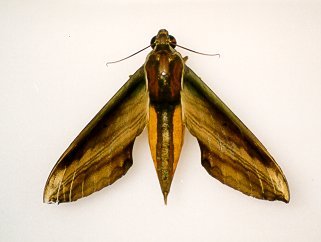
Yam Hawk-moth - first for county and the
country? - Tony Prichard
On the 4th of August I was contacted by David Lampard of the Ipswich
Museum. He informed me that a Mr Fountain had handed in what they
thought was a Silver-striped Hawk-moth, which had been found near
Felixstowe docks on the 1st August. I popped down to the museum at
lunchtime and was able to tell David that it was not a Silver-striped
Hawk-moth but that I didn't know what it was other than being a
hawk-moth of some sort. Referring to Pittaway's Hawk-moths of the
Western Palearctic I couldn't find anything which looked remotely like
it. This started me thinking that this moth must have come from a long
way away. I put a picture of the moth up on a moth-related web site and
Martin Honey of the Natural History Museum came up with an identity of
the Yam Hawk-moth (Therestra nessus) and also a web site were I could
check the moth against a reference photo. This Yam Hawk-moth is native
to the orient from India to Japan and Australia, where the larvae of
the moth are considered to be an agricultural pest feeding on yams and
other related plants. Apparently this species has not been recorded in
the country before so a British first for Suffolk! - even though it
almost certainly had been assisted by man in its passage.