The Suffolk Moth Group's event list for 2002 is now available and accompany's this newsletter - click here to view. This year we are again holding meetings every Friday night during May to September at various sites around the county. There are a few daytime meetings as in previous years and hopefully members will find time to get along to one or two of these meetings which have a tendency to be not so well attended as the moth evenings. The programme starts with an evening larval hunt at Lower Hollesley Common on the 12th April.
The group held its first open indoor meeting in January which was well attended on the day. Based on feedback I have had so far it seemed to go well so we will almost certainly be organising a similar event for next winter. While it is still fresh in the minds of people who attended I am keen on getting some feedback from people who attended. How did people feel the day went? Is there anything that members would like to see at the next meeting? Was the museum a covenient venue? There is no parking near the museum but it helps support the museum by holding such events there (and it doesn't cost the group anything).
I have heard from Brian Goodey in Essex that one of the Essex Moth Group members was attacked and stabbed while out moth recording in the south of Essex last year. Fortunately we seem to have avoided any such trouble up to now (although we've had the odd minor disturbance) and hopefully it will stay that way. However, I would caution members to bear in mind their own safety when out recording in the field - especially when on their own.
For those of you
who let me have contact details for the directory of Suffolk moth recorders
then I will shortly be emailing this out.
The book will include all species of moths recorded from Essex with distribution maps for most species: 2km squares for macrolepidoptera, 5km squares for microlepidoptera. Flight-time graphs for 411 species where sufficient data is available. Monochrome photographs by Ian Rose and others of most resident macro-moths, taken in Essex of living moths in natural resting positions (those that were at the indoor meeting will have seen the quality of Ian Rose's slides). Status, habitats and foodplant information for every species from Essex data (not just a repeat of what is in the national books) . Special chapters include "Recent Population Trends" (Dr Chris Gibson) & "Fisher's Estuarine Moth - an Essex speciality" (Zoe Ringwood). Approx. 300 pages of text, maps, charts and monochrome photographs, plus 8 pages of colour plates. Hardbound with colour cover from a specially commissioned painting by Alan Harris.
A pre-publication offer of £16.50 (+ £3.25 p&p) for the book is available. Details and order form are available form the Lopinga Books web site at www.lopinga.co.uk.
Alternatively they
may be contacted at Lopinga Books, Tye Green House, Wimbish, Saffron Walden,
Essex, CB10 2XE. Email : lopinga@aol.com or telephone 01 799 599
643.
Harley Books (B.H.
& A. Harley Ltd.) can be contacted at Martins, Great Horkesley, Colchester,
Essex CO6 4AH. Telephone 01206 271216.
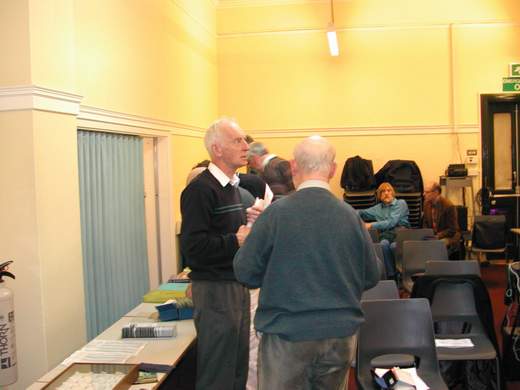
The meeting started
with Tony Prichard, the county recorder, reviewing the previous year’s
activities and moths. The field meetings were discussed, of which the ‘moth
nights’ were well attended. There were some memorable ones, with the highlights
mentioned by the members being Redgrave Fen (where 190 species were recorded),
Orfordness (a night of few moths but what an adventure!) and Walberswick
(where it was uncomfortable near the light due to the large numbers of
biting mosquitoes!). Daytime events however were poorly attended with just
2 members most of the time. It was stated that these could be just as important
as moth nights, as some moths fly only during the day, and larval searches
prove a species breeds on a site.
The surveys the
moth group did were discussed – the White-mantled Wainscot being recorded
from 3 sites during the year and the Ground Lackey larval hunt that produced
some new records.
The eagerly awaited new events list was released, with the target projects for the new season including a survey of Chalk Lane (in the King’s forest), before it is turned into a public road, more site surveys for White-mantled Wainscot and a search for White-spotted Pinion at Kenton Hills.
After a break for refreshments, it was the turn of members of the group to show their slides. Jon Clifton showed the group some of the moths he saw during the year in the counties of Norfolk, Suffolk, Essex and Staffordshire, including such delights as the Light Knotgrass and Sandhill Rustic. Then it was yours truly who showed a selection of slides of the nice moths seen by the group during the season including Wood Carpet, Ground Lackey (larvae and adults) and Oak Lutestring. I then went on to show a brief overview of Ipswich golf course and some of the moths I caught during the year including Red-necked Footman and Goat Moth.
After lunch, Ian Rose and Joe Firmin from the Essex moth group entertained us with slides and stories of their activities ‘south of the border’. Ian Rose’s slides are well known by those of us who have attended Essex moth group meetings in the past of being of the highest quality. It was of interest to see moths regarded as rare there can be quite common here (e.g. Maiden’s Blush), and to see the life cycles of some of the species they have bred through. Of course, the Fisher’s Estuarine moth made an appearance, as some of us expected!
This was followed by a short talk from Jon Clifton about his company, Anglian Lepidopterist’s supplies. He showed us the various moth traps up for sale, along with other products such as microscopes, specimen tubes and bulbs.
Following another coffee break, the next session was free for people to view the various exhibits around the room, as well as a chance to view the collections of lepidoptera stored at the museum. There was a good display of various items around the room, including specimens taken during the 2001 season, a range of moth books, information fact sheets as well as the ALS stand.
This session also gave time for people to chat and catch up on all things moth wise, before we all went home at 4pm.
The reactions on the day were that everyone had a good time and found it of interest, so it looks like this event will be a permanent addition to the Suffolk moth group calendar!
Thanks go to Tony for organising the day, the museum for having us and all others who brought along exhibits or slides, and thanks to all who attended to make the day such a good one. See you next year!
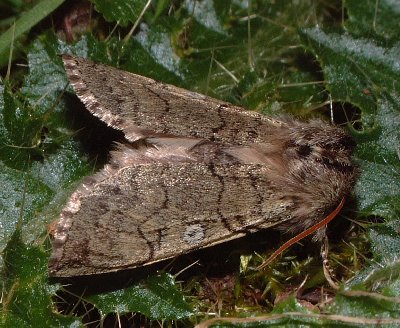
As this species currrently has no English name Colin Plant has suggested that it be called Langmaid's Yellow Underwing.
Although similar to the Lesser Broad-bordered Yellow Underwing recorders will be pleased to hear that the two species can be distinguished on external features alone.
The differences in appearance are summarised below (for full details I'd suggest you read the article)
All these (and other
similar comparative comments) are very useful when comparing set specimens
in a series but nowhere near as helpful with live moths in mercury vapour
light. In 1906 Dr. Chapman read a paper at the City of London Entomological
Society in which he said from personal experience and breeding both species
he was able to separate them with practical certainty but also expressed
his “absolute inability to lay down any characters by which someone unfamiliar
with these two species” could do so. However, a number of the points
he made can be used to make accurate identifications of some individuals
of both species and I summarise them below.
Colour of the hindwing: a male specimen with quite white hindwings is almost certainly tridens, with very slight dark scaling is probably tridens, with moderately dark scaling is probably psi and with very dark scaling is certainly psi. In summary males with dark hindwings are always psi while males with white hindwings are sure to be tridens.
Colouration: psi is pure black and white; tridens has red, green, brown and yellow. The pale form of psi, with white predominating, is probably unmistakable; so in tridens when richly suffused with pink, brown or olive. Tridens very commonly has the interior of the orbicular stigma coloured, or definitely of a different tint from the rest of the wing; psi almost always has it of the same colour as the rest of the wing.
Marking:
the separation of the marginal dots from the anal dagger in psi;
and their junction, especially the upper one, with it in tridens
is more constant than any other in the markings, still it has exceptions.
By using all three characters described above it is possible to identify, pretty certainly, those specimens of these two species that show the extremes as outlined above, particularly if they are males which I find are more regular visitors to light.
[Editor's Note: Being
able to identify at least some of the Grey/Dark Daggers externally will
certainly be useful but until the above features are confirmed further
the Suffolk Moth Panel will still be requiring that records of adults of
these species are confirmed by genitalia. I will be very interested to
hear from recorders who use these features to determine Dark/Grey Dagger
species and additionally confirm the identity by the usual means]
Apparently the moth has not been recorded from Suffolk previously. I have no records for the species in the database and Morley states that we were unlikely to pick up this species in the county.
This could be a species
worth looking for in the future.
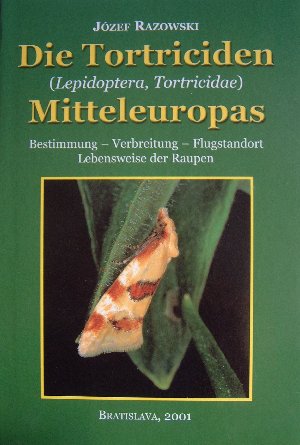
The tortrix moths are one of the families of the micro-lepidoptera which attract more general interest as they are reasonably large as far as micro-lepidoptera go and can be quite attractive in appearance. The problem for people wishing to study this group is that the standard reference for this family, the two volumes of British Tortricoid Moths by Bradley, Tremewan and Smith, is now out of print and can be expensive or hard to obtain second-hand.
Die Tortriciden Mitteleuropas is the third and latest book in a series about middle European lepidoptera which have all been produced with German text. As I don't speak German I cannot really comment on the textual content of this book too much.
The first section of the book is a checklist of the species covered along with synonyms. This will be of use as some of the terminology in the book is different to that used in the latest Bradley checklists and with which most UK lepidopterists will be familiar with. Thanks are due to Ian Dawson who has produced a spreadsheet of the terminology differences between the Bradley and Razowski. Ian can be contacted via email at ian.dawson@lineone.net for a copy of the spreadsheet. After working through the checklist it appears that the book provides very good coverage for the UK fauna with 94% of the 384 species from Bradley's checklist included. Of the missing species most are casuals in the UK but there are some common tortrix moths missing from the book including; Ditula angustiorana, Epiphyas postvittana and Lozotaeniodes formosanus.
The species accounts are rather brief and take up only 72 of the 319 pages in total. Even though the text is in German there appear to be three pieces of information that non-German speakers will be able to easily use; lifecycle information for each stage is given as numerals, scientific names are used for foodplants and the wingspan is specified in millimetres
The main reason I bought this book was for the 150 pages of genitalia drawings (of tortrix moths) which form the major part of the book. These are clear and well drawn, covering both male and female genitalia. The British Tortricoid Moth volumes includes very few genitalia drawings, so this book may make a useful addition if you're interested in this subject.
The section of the book containing the plates will probably be the main interest for most people. All twenty four plates are of photographed set specimens. The pictures of the moths are reasonably clear and of good quality and will enable most species to be identified from the plates. One annoying feature of the plates is that they have shrunk or expanded the pictures of the moths so that the individual moths all appear to be roughly the same size, so that they line up neatly in columns and rows on the plate. Hence it was quite important that they specified the wingspan size in the species accounts.
The main drawback
of this book is the lack of textual information, at least to the non-German
reader, covering areas such as habitat, distribution, confusion species
and key identification features. This forces the recorder to rely solely
on visual matching with the plates. As a consequence I would use this book
with caution as a primary identification guide to this family of moths,
especially where there are several similar species from which to choose.
Jeff Higgott has recently launched a web site consisting of pictures of over 650 species of moth and butterfly which can be found at http://go.to/uklepidoptera.
The Lepidopterogical Society of Finland has its own web site http://www.perhostutkijainseura.fi/, the only problem being that most of the text is in Finnish (not surprisingly) although there are English summaries in places. There is a particular section on the Finnish Gelechiidae at http://www.perhostutkijainseura.fi/sps_gelechiidae.html with a range of good quality large size photos of pinned specimens.
The Biological Records Centre at Monks Wood (quoting from the web site) is the national custodian for data on the distribution of wildlife in the British isles. The site covers the NBN Gateway (a pilot in giving internet access to species data eg distribution maps), details of the national recording schemes, atlases and recording cards - amongst other things. The site can be found at http://www.brc.ac.uk
A Dutch site at http://www.xs4all.nl/~wnellis/
covers the leaf-mining species of insects (not just moths). I suspect,
unless you can speak Dutch, that this site's appeal will lie in the pictures
of leaf-mines. Coverage is not complete but most of the common species
are covered. The photographs of the mines are backlit so you can easily
see the pattern of frass.
 |
 |
|
|
|
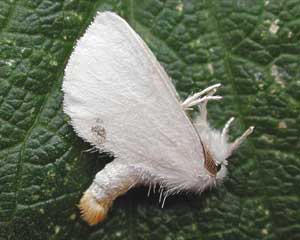
I have found no mention of this behavioural difference in an admittedly limited search of the literature.
Jeff Higgott jeff@higgott.info
[Editors note: The
records in the database show that the Brown-tail, as far as Suffolk goes,
is almost exclusively found in the coastal eastern vice-county, with just
one or two records just creeping into West Suffolk. Yellow-tail is widespread
across both vice-counties]
This survey was prompted by conversations with Nick Gibbons of English Nature and Gerry Haggett. I understand that recently English Nature have instituted a habitat management regime of grazing by sheep in the Brecks. This has raised concerns that the sheep may be destroying the habitat required by the Lunar Yellow Underwing larva - which feeds on fine heathland grasses. Gerry Haggett and others have been surveying areas of the Brecks to ascertain whether in fact the larvae have been adversely affected in that area. To complement this survey a few of us have been surveying the Sandling heaths where the species has also been recorded.
Although several visits have been made we have managed to find no larvae of Lunar Yellow Underwing on the Sandling heaths to date, although surveying will continue to the end of the month. I gather from Gerry Haggett that they are having better results in surveying the Brecks.
However, the time has not been wasted as we've been running light traps at the same time and have picked up some records for these areas which are not normally visited at this time of year. In addition, other species of larvae have been recorded which provide useful larval records for the sites.
Species of larva
recorded included; Square-spot Rustic (abundant everywhere), Lunar Underwing,
Large Yellow Underwing, True Lover's Knot, Yellow Shell and Angle Shades.
 |
 |
 |
|
|
|
|
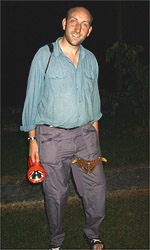
Unlike me, Barry had come prepared. A simple funnel moth trap and white sheet were set up in the rest house garden. Obvious enthusiasm was kept in check by the generator being turned off before midnight each evening.
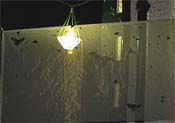
Moth trapping at
1000m in Malaysia is an experience encouragingly free of biting insects.
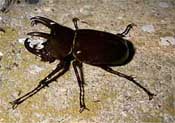
The main hazards for us were the Atlas Beetles Chalcosoma atlas
attracted to the light. Whilst these don’t bite or sting they are
HUGE and tend to fly straight for the head! The main hazard for the
moths was the Brown Wood Owl which sat in a tree nearby and would regularly
swoop down and take the larger moths in mid air. The quiet (apart
from the generators) of moth trapping in the wilds of the UK contrasts
with the racket of Malaysian cicadas, which sit on the trap and squeal
away to the world.
 |
 |
 |
|
|
|
|
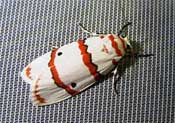
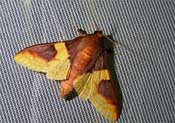
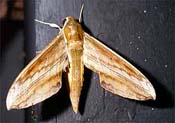
Barry was tooled up with the available field guides and handbooks and camera but many of the moths trapped have had to remain completely unidentified. Many of these are quite possibly new to science – the potential for breaking new ground in Asia would be huge for a dedicated recorder with several lifetimes to spare.
For a complete novice
on Far Eastern moths the experience was amazing - the variety and colours
too much to take in. Many moths could be easily pigeonholed though.
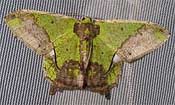
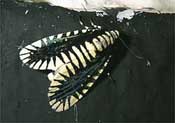
There were about 10 species of hawk-moths up to Death’s-head size.
There were geometers – emeralds boldly patterned and the size of Red Admirals.
There were cossids the size of a large hawk-moth. There were others
from families not represented in the UK with amazing patterns and combinations
of lime and black or red, white and blue.
 |
 |
|
|
|
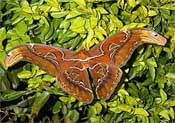
What was the most impressive moth seen? Without doubt the Atlas Moth Attacus atlas. This species has one of if not the largest wingspan of any moth, approaching 30cm. We saw a few of them and they really are amazing with their “snake’s head” wingtips and transparent windows in the wings. It is amazing to believe that their tiny bodies can power such enormous wings – in flight they look remarkably like a child’s wind-up toy.
The combination of wildlife (moths, bird-wing butterflies, birds, monkeys, gibbons…), scenery and temperature (encouragingly cool after the heat and humidity of Kuala Lumpur) makes Fraser’s Hill a must for any visitor to Malaysia.
All photographs are
© Barry Stewart 2000.
Along with the unseasonable weather, some unexpected moths also appeared, well outside what I would call their normal flight times. Species seen were: White Ermine (on 3rd), Straw Dot (11th), Carcina quercana (22nd) and Orthopygia glaucinalis (on the 9th and 11th). Either the warm weather tricked them it was time to emerge, or they were possible migrants, although not many ‘usual’ migrants appeared during this time with only singletons of Silver Y, Plutella xylostella and Turnip being recorded.
The warm conditions increased the number of resident moths normally seen at this time of year as well. For example, the Streak, a common species here is normally recorded in numbers of 10 – 20 for the year. This year there have been 89!
Best night was the 11th/12th, when 31 species were trapped (25 were macros) along with a Red Admiral butterfly! Species of possible interest were: Acleris rhombana (good to see on 2 occasions not common here), Caloptilia betulicola (2 on the 22nd), Mallow (1 or 2 a night), Spruce Carpet (common), Pale November Moth (1 picked out from the more common Novembers on the 24th), Merveille du Jour (2 recorded), Flounced Chestnut (3 seen), Rosy Rustic (a late individual on the 14th), Large Wainscot (2 seen) and an Oak Nycteoline (on the 11th a nice pinkish form). A Red-green Carpet was trapped on the 22nd, a new site record.
A hairy caterpillar was handed to me on the 29th to identify, found feeding on geraniums at the clubhouse. It turned out to be an Oak Eggar – this is the second record of a larva this year, the first being found in the same area, this time feeding on ornamental heather! Also seen on its daytime flight at the end of the month (29th) was the first Diurnea phryganella of the year.
The hunt for leaf-mines continued this month, with 22 species being recorded on various trees and shrubs around the site, including Parornix scoticella (on Rowan) which is not on the current checklist.
By November the weather broke, and virtually no light trapping was done all month. The Robinson was only put out once (on the 18th), and it caught 2 moths: Northern Winter Moth and a Streak.
At this time of year the security lights around the clubhouse produce more moths – species such as Mottled Umber, Scarce Umber, December Moth and Northern Winter Moth all put in appearance towards the end of the month here. Other daytime moth sightings of possible interest, mostly seen while coppicing gorse were: Streak, Acleris cristana and Ypsolopha ustella. The tunnels of Lunar Hornet Clearwing moth were also seen while coppicing sallows (on the 1st) – the caterpillars always seem to be at the exact point where the tree is cut though, so there is not much left of them when they are revealed!
The main thrust of recording during the month has been leaf mines – it certainly has been a bumper season with the leaves staying on the trees for longer than normal. This has made it easier to find species that normally feed once they have fallen. 40 species were recorded, including 6 new site records – the most interesting being Heliozela resplendella that mines the midrib of alder leaves, eventually cutting out a case, leaving a distinctive hole behind.
No moth trapping
was done at all during December, and very few moths were seen at all! Only
the ubiquitous Winter Moth and Mottled Umber appeared at the clubhouse
security lights. Of possible interest was the daytime discovery of a specimen
of Acleris logiana, a new site record. Last moth of the year was
an
Alucita hexadactyla, flying round in the tea sheds.
Unfortunately the
mild conditions did not continue into February – nights were either cold,
windy, wet or a combination of all these! Despite this, trapping was attempted
on the 11th and the 26th, with the former date producing just over a double
figure of moths, with the usual March Moth, Pale Brindled Beauty and Tortricodes
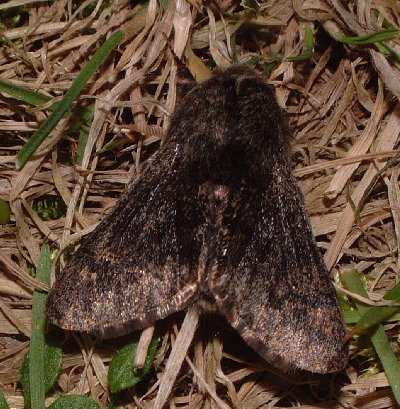
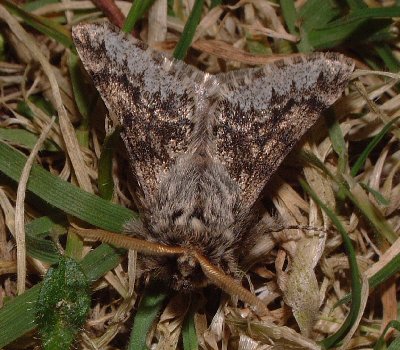
alternella appearing. The first Small Brindled Beauty of the year was
also present, followed by 2 more on the 26th (the only moths caught that
night!).
 |
 |
|
|
|
Of more interest were my daytime discoveries. Acleris logiana was found on 2 dates (1st and 25th) after first being recorded last year. As usual, Agonopterix umbellana was found while coppicing Gorse, its foodplant. Whilst walking past the clubhouse rose-bed on the 8th, I noticed a large cocoon on one of the plants. This turned out to be an Emperor cocoon, almost certainly from one of the larvae that I found feeding there last year. Its pretty big so is probably a female, so hopefully if it emerges I will try assembling some males.
The moth that caused
a stir due to its appearance was the Pine Beauty noted under the clubhouse
security lights on the 8th. This is earlier than any of the currrent records
in the county moth database for Suffolk. This moth has also appeared here
in early June!
 |
|
|
 |
|
|
Please send any
Suffolk moth records, moth articles or other queries to me at (preferably
via email):
3 Powling Road, Ipswich,
Suffolk IP3 9JR
Email : tony.prichard@btinternet.com
(also tony.aw.prichard@bt.com
)
Suffolk Moths web site (home of the SMG): http://www.btinternet.com/~tony.prichard
SMG Email Discussion Group: http://groups.yahoo.com/group/suffolkmothgroup
Essex County Moth
Recorder : Brian Goodey, 298 Ipswich Road, Colchester, Essex. CO4 0ET.
E-mail: brian.goodey@dial.pipex.com
Good quality at low prices
Full range of entomological
supplies.
MV and actinic Moth traps.
MV, Blended and Black bulbs
in stock. Dissection equipment, Chemicals, Microscopes, Generators, Entomological
cabinets, collecting tubes etc.
For full details send a
SAE to:
PO Box 232, Northwich Delivery
Office,
CW8 3FG. Or phone 01263
862068
Website : http://www.angleps.btinternet.co.uk/
Proprietors: J Clifton & A Wander