Field
reports - Tony Prichard
14th April 2006 - Moth Night at Tangham Forest
A visit to our favoured spot in Rendlesham/Tangham Forest, with
heathland, wet woodland and conifer plantations in the vicinity. A
rather disappointing list of 11 species; Water Carpet, Yellow Horned,
Early Grey, Engrailed,
Diurnea
fagella, Satellite, Common Quaker, Hebrew Character, Clouded
Drab, Pine Beauty and Chestnut. Not too surprising though given the
poor season prior to this date.
22nd April 2006 - Moth Night at Captain's Wood
Another moth night with a short species list at a time when normally
lists should be increasing and some of the more colourful moths should
start appearing on the wing. Eight species recorded during a rather
cold night; Hebrew Character, Lead-coloured Drab, Brindled Pug, Small
Quaker, Clouded Drab, Common Quaker,
Eriocrania
subpurpurella and
Diurnea
fagella.
28th April 2006 - Moth Night at Reydon Wood
A week later and things have not improved by much, with just ten
species recorded at this ancient woodland SWT reserve. Species recorded
were Water Carpet, Early Thorn, Common Carpet, Small Quaker, Hebrew
Character, Powdered Quaker, Early Grey, Clouded Drab and
Eriocrania subpurpurella.
30th April 2006 - Moth Night at Friday Street
Things were really picking up now - 13 species recorded! A rather brisk
wind may not have helped as we sought more sheltered sites for the
lamps in this river valley site amongst the pine plantations of
Rendlesham Forest. Species recorded were Satellite, Frosted Green,
Brindled Pug, Lunar Marbled Brown, Common Quaker, Clouded Drab, Hebrew
Character, Great Prominent, Red Chestnut, Grey Birch, Water Carpet,
Diurnea fagella and
Eriocrania subpurpurella.
5th May 2006 - Moth Night at Bonny Wood
Last year's visit to this site, an ancient woodland SWT reserve, was
cancelled due to bad weather and weather conditions were not ideal on
this night. A trap positioned next to a stand of aspen did rather
well for numbers of Seraphim. Other species recorded included Hebrew
Character, Lunar Marbled Brown, Nut-tree Tussock, Small Quaker, Frosted
Green, Common Quaker, Brindled Pug, Purple Thorn, Latticed Heath,
Clouded Drab, Chestnut, Powdered Quaker, Engrailed, Shoulder Stripe,
Eriocrania subpurpurella and
Plutella xylostella. It was quite
unusual to find a single
Micropterix
calthella coming to light, this is normally a day-flying
species, found in the flower-heads of buttercups and Marsh Marigold.
12th May 2006 - Moth Night at Holly Grove, Covehithe
Holly Grove is an area of woodland adjacent to Benacre Broad, with
pasture and reed-beds in close proximity to the wood. With five lights
- two were placed in a wood adjacent to the carr and reed-bed, while
the other three were placed in Holly Grove wood itself. A fair
selection of spring-time species were seen - Water Carpet, Scalloped
Hook-tip, Purple Thorn, Frosted Green, Small White Wave, Grey Birch and
Peach Blossom. Other species of note recorded were
Acleris logiana, and threefrom the
area next to the fen - Reed Dagger, Red-green Carpet and Flame
Wainscot.
A moth netted at the sheet light by Neil Sherman during the middle of
the session, on first glance appeared to be an Oblique Striped - an
unusual moth to see away from the Brecks. On further inspection it
turned out to be a Many-lined - now a rare migrant to the country with
less than ten recent records. After the event we found out that
another Many-lined had turned up earlier the same day in Norfolk and
later in the week a third one was also recorded in Norfolk. Since
then three further Suffolk records have been made at Bawdsey by Matthew
Deans, Minsmere by Robin Harvey and Dunwich Heath by Clive Moore
et al.
13th May 2006 - Moth Night at Hintlesham Wood
A return visit to this RSPB ancient woodland site on a rather cool
night. Only nineteen species recorded, including Coxcomb Prominent,
Orange Footman, Scorched Carpet, Lime Hawk-moth, Lesser Swallow
Prominent and Knot Grass. The only excitement (if you could call it
that) was when we had shut down all the lights and were trying to find
our way out of the wood - at night once you have lost your bearings in
a wood with no paths it is rather hard to regain them, although after a
bit of wandering round laden down with kit we did manage to find the
way out.
19th May 2006 - Moth Night at Old Hall Wood
This meeting was cancelled due to rather inclement weather.
26th May 2006 - Moth Night at Hinderclay Fen
A visit to one of the fens on the Norfolk-Suffolk border with fen,
alder carr, oak and birch scrub and acid grassland habitats. The rain
of the previous days had made the long track to the reserve a little
slippy, with a few cars wobbling as they went down and later came back.
A fair night but with five lights running a rather short species list
indicated that the season was still running late. Forty five species
recorded with notables including Poplar Lutestring, Seraphim, Reed
Dagger, Small Elephant Hawk-moth and
Plutella
porrectella.
2nd June 2006 - Moth Night at St Olaves
This night was arranged by Keith Knights with the kind permission of
the Somerleyton Estate. Apparently an un-recorded site, with fen and
woodland habitats, where we were told nobody had been for at least
three years. It looked it as well with tall nettles and thistles clumps
scattered over the area. After traipsing over the site through the long
prickly vegetation we eventually set up five lights covering both
woodland and fens areas. A clear night and dropping temperatures meant
that only forty-eight species turned up at the lights, although the
cold temperatures did not seem to keep the multitudes of biting midges
away. Some of the more interesting species recorded were Orange
Footman,
Nemophora degeerella,
Gold Spot,
Nascia cilialis,
Birch Mocha and Clouded-bordered Brindle.
8th June 2006 - Moth Night at Lower Hollesley Common
A mid-week visit to one of the groups favourite haunts - an area of
heathland in the Sandlings with a conifer and beech wood nearby. Some
of the fifty four species recorded were Clay Triple-lines, Orange
Footman, Peacock, Cream-spot Tiger,
Pyla
fusca, Small Elephant Hawk-moth, Marbled Brown, Lobster, Bird's
Wing, Barred Red, White-point, Grass Wave and Ochreous Pug.
9th June 2006 - Moth Night at Cavenham Heath
An English Nature heathland reserve in the Breckland area. We set up in
the birch woodland in the middle of the heath, which meant we avoided
the youths larking about in the planned trapping area and also gained
some cover from the breeze blowing across the open heath. Sixty-four
species recorded from four MV lights, rather disappointing for this
time of year. Possible species of interest included Small Elephant
Hawk-moth, Bird's Wing, True Lover's Knot, Clouded-bordered Brindle,
Cream-spot Tiger,
Orthotaenia
undulana,
Eulia ministrana,
Narrow-winged Pug,
Scrobipalpa
costella, Orange Footman, White Colon, Pale-shouldered Brocade,
Sharp-angled Carpet,
Caloptilia
robustella, Four-dotted Footman and Grey Carpet.
10th June 2006 - Moth Night at Old Hall Wood
As the visit to this wood planned for earlier in the year was cancelled
we decided to slot in this visit to this ancient woodland in the
Bentley area. Unfortunately large areas of the wood have
previously been re-planted with conifers. Six MV lights were placed in
the areas of the wood with broad-leaved trees, although coniferous
areas were never too far away. Weather conditions were rather good and
at last we were getting the sorts of numbers expected at this time of
year. Over 110 species were recorded on the night. As far as I can
recall this is the only site where we have had
Alabonia geoffrella to light -
twice now with the first time during last year's visit. It makes me
wonder how many would be seen flying during the daytime. Species of
note included
Cochylis nana,
Clay Triple-lines,
Eulia ministrana,
Incurvaria oehlmanniella,
Pseudotelphusa scalella, Poplar
Lutestring, Beautiful Carpet, Grey Pug, Orange Footman,
Orthotaenia undulana,
Lobesia reliquana,
Tinea trinotella, Lobster,
Broken-barred Carpet and Festoon,
16th June 2006 - Moth Night at Redgrave Fen
On this night we returned to the area of the reserve where we were
sited at our previous
visit, the western end of Redgrave Fen. A clear sky did not promise
well and moth activity at the
lights was rather slow initially (although not midge activity) with a
later increase in moth activity coinciding with the sky clouding over.
This late activity
helped boost the species total for the night to over 140 species.
While clearing up the traps at the end of the night a pair of Lime
Hawk-moths were found
in cop.
on a tree next to a trap. Some of the more interesting species
recorded included
Nascia cilialis
at dusk, Pinion-streaked Snout, Valerian Pug, Reed Dagger,
Brahmia
inornatella,
Schoenobius
gigantella,
Taleporia tubulosa,
Cream-bordered Green Pea, Sloe Pug, Orange Footman, Striped Wainscot,
Phlyctaenia perlucidalis, Large
Nutmeg,
Pempelia formosa,
Campion and
Stathmopoda pedella.
The star of the night was an Alder Kitten spotted on the sheet by
Neil Sherman, that must have arrived when we had been away checking the
traps - a very elusive and infrequently recorded moth in Suffolk the
exact status of which I am still looking into when I can track down the
relevant SNS Transactions..

|
Alder Kitten © Tony Prichard 2006
|
17th June 2006 - Moth Night at Snape Warren
A slightly quieter night than the previous one at this heathland site
managed by the RSPB. Since our last visit most of the birch scrub in
the area we record has been removed and good views of Nightjars could
be seen flying over the now open heathland. Over 90 species recorded
including Cream-spot Tiger, Grass Wave, small Elephant Hawk-moth, True
Lover's Knot, Lunar Yellow Unerwing, Pinion-streaked Snout, Fox Moth,
Cream-bordered Green Pea, Large Nutmeg, Dark Spectacle, Orange
Footman, Peacock, Small Clouded Brindle, White Colon,
Agdistis bennetii (a wanderer from
the saltmarshes), Broad-barred White, Lobster and
Orthotaenia undulana.
22nd June 2006 - Moth Night at Upper Hollesley Common
A mid-week visit to this Sandlings heathland site managed by the SWT
where we managed to record 98 species. Species of note included Grass
Wave, Cream-spot Tiger, Shaded Fan-foot,
Pempelia palumbella, White Colon,
True Lover's Knot, Small Elephant Hawk-moth. Birch Mocha, Brindled
White-spot, Barred Red,
Eulia
ministrana,
Anania verbascalis,
Bird's Wing, Lunar Yellow Underwing, Broom Moth,
Cydia fagiglanda,
Epinotia demarniana, Grey Arches,
Plain Wave, Orange Footman and Pinion-streaked Snout.
23rd June 2006 - Moth Night at North Cove
After last year's successful visit to this SWT reserve in the north of
the county we had high hopes for the site. Unfortunately the weather
conditions on the night appeared very similar to Redgrave Fen when we
had a slow start to the evening. The forecast mentioned that it would
cloud over at some stage in the evening and we hoped that this would
produce a similar increase in moth activity. As it turned out the sky
stayed clear and the 110+ species recorded was considered a bit on the
low side for the six MV lights set up. A Beautiful Carpet was spotted
in the path-side vegetation as we were setting up. Other species
of note included Phoenix, Small Seraphim, Phlyctaenia perlucidalis,
Pinion-streaked Snout, Plain Golden Y, Cream-bordered Green Pea,
Valerian Pug, Lobster, Green Arches, Lilac Beauty, Small Clouded
Brindle and
Epinotia demarniana.
30th June 2006 - Moth Night at Captain's Wood
An event for which a few people had high expectations given the recent
weather and woods are normally very productive at this time of year. On
the night temperatures dropped sharply and the cars parked out on the
field next to the wood were enshrouded by mist and temperatures inside
the wood were little better than out on the field. The list at the end
of the night stood at over 120 species with 8 MV lights and but moth
activity in general was slow throughout the evening. A Lunar Yellow
Underwing made an early appearance at the sheet (positioned not too far
from the field where the larvae where found earlier in the year). Other
species recorded included Gold Swift, Shaded Fan-foot, Grey Arches,
Anania verbascalis,
Epinotia demarniana, Broad-barred
White, Lobster, Sharp-angled Peacock, Large Emerald, Broom Moth,
Taleporia tubulosa, Purple Clay and
Brindled White-spot.
Reports
from Recorders around the county
Records reported in
this section have not been checked by the Suffolk Moth Panel. Many
thanks go to the recorders who provide write-ups and records for this
section.
Eye Moths, January to late June 2006 - Paul
Kitchener
With only four moths seen in the garden during January and February,
none in March until the 19th and only nineteen species in April, 2006
had the worst start to any year since I began recording ten years ago.
A wet and windy May delayed things further but at last some fine
weather in June has kick-started the Eye nightlife just when the trap
seemed in danger of becoming just another useless piece of garden
furniture.
March
March was noteworthy for the complete absence of Orthosia species until
the 26th, by far the latest start that I’ve ever recorded. They never
really made up for lost time and the totals for all species were the
worst ever. Three unrelated species, that are usually expected, were
not seen at all this spring, namely Pale Brindled Beauty, Early Moth
(though never in any numbers) and Dark Chestnut. Excitement this month
was limited to a Grey Shoulder-knot on the 19th and two Satellites
(which is twice last year’s total!).
April
This April was by far the worst I‘ve known, ten species on the 13th was
the best the month could offer. These included
Agonopterix
alstromeriana, Engrailed and the only Twin-spotted Quaker of the
year.
A
Depressaria heraclei on the
27th was only the second site record.
May
The species total for this May was also the worst in ten years, though
three of the species were first records, not only for this site but
also Eye (according to my observations anyway).Two of them had been
expected for some time, the other was more of a surprise. The first was
Epiphyas postvittana on the
11th (a second was to follow in June), next
was a Pine Hawk-moth on the 12th and then an Ochreous Pug on the 13th.
There had obviously been a movement from a pine tree somewhere as the
only Spruce Carpet of the year, so far, was trapped on the 12th.
The few other records of note amongst the paltry seventy one species
included
Incurvaria masculella
(third site record, 15th),
Argyresthia
trifasciata (second site record, 26th, a year and a day after
the
first),
Plutella xylostella
(fourteen over two days, 3rd and 4th),
Orange Footman (11th) and Buttoned Snout (the sixth site record, 11th,
all but one having been in spring).

|

|
Incurvaria
masculella © Paul Kitchener 2006
|
Ochreous Pug © Paul Kitchener 2006
|
The Prominents have been very hard to come by this year, particularly
Swallow Prominent which is usually recorded in good numbers and no Iron
Prominent has been seen for the second consecutive spring. On a
positive note, Purple Thorn and Chocolate-tip both appeared in better
numbers this year.
June
With minimum night time temperatures creeping into double figures
things could only get better and although compared with some other
Junes it hasn’t been exceptional (so far) it has seemed so after such
an appalling five months or more.
One of the warmest nights in Eye was that of the 12th and it inevitably
produced the best catch of the year so far with seventy eight species.
These included
Pammene aurita,
Eudonia pallida,
Pempelia formosa (one
of my favourite micros and not seen at all last year),
Phlyctaenia
perlucidalis, Sharp-angled Peacock, Orange Footman (one of seven
this
year, previously recorded as singletons), Sycamore, Herald and Rosy
Marbled (first record).

|

|
Pempelia
formosa © Paul Kitchener 2006
|
Rosy Marbled © Paul Kitchener 2006
|
Of the other micros seen this month the following were also locally
notable:
Argyresthia cupressella
(first noticed in 2003 and now
regularly seen for a week or two every June),
Prays fraxinella (a dark
form, 18th),
Plutella xylostella
(maximum twelve, 11th),
Luquetia
lobella (third record, 11th),
Ephestia
parasitella (now one of the most
frequently seen pyralids in June, maximum eight, 17th) and
Sciota
adelphella (fourth record, 23rd, a year to the day since the
third). It
is possible that this last species is a local resident, there is
certainly plenty of poplar and willow within a few hundred yards of the
garden.
The more interesting macros were Scallop Shell (third record, 16th),
Foxglove Pug (15th, the first since 2003), Freyer’s Pug (three),
Currant Pug (three), Treble Bar (fourth record), Bordered White (second
record, 18th), Shears (four; recorded for the first time only last
year), White-point (two; also recorded last June and probably is now
established locally), Small Clouded Brindle (three), Marbled White Spot
(fourth and fifth records), Shoulder-striped Wainscot (first site
record, 22nd) and Sharp-angled Carpet (first site record and the first
I’ve seen in Eye since 1997).

|

|
Sciota
adelphella © Paul Kitchener 2006
|
Scallop Shell © Paul Kitchener 2006
|
In terms of apparent population changes, so far this year, Clouded
Border, Swallow Prominent and Pale Prominent numbers are well down but
Mottled Pug, Pale Tussock, Small Square-spot (already the total is more
than double that for the whole of last year), Rustic Shoulder-knot and
Straw Dot are having a very good year. Last year was very poor for
Silver Y so it is very pleasing to see more about this year, the total
trapped alone being more than double that seen/trapped in 2005.
25 June 2006.
Slow, slow, slow, quick, slow? -
Mothing in Woolpit in 2006 - Paul
Bryant
Before I start, I have questions for you all - How many species of
hawk-moth could you have seen on the wing on November 30th? (my answer
appears at the end of this article … no cheating, please)
So what of 2006? The title of this article kind of gives it away as
most of us seem to have spent the first three to four months wondering
if there were any moths out there to be caught. Certainly, my own
records show that I trapped only once in the garden during a brief mild
spell in February but caught nothing. In fact, it wasn’t until the last
week of March that spring finally seemed to arrive. The winds had
switched to a more southerly direction, Wheatears and Swallows started
to appear along the south coast and both day and night-time
temperatures seemed to almost double within the space of 24 hours. At
last, it was time to dust down the trap and put it out. And what did I
catch, a single Common Quaker. Oh well, at least it was a moth!
But there’s more …. I just happened to be in our shed the next day when
something caught my eye. There, crawling around in the bottom of the
pot that had contained two pupal cases all winter was a freshly emerged
male Small Eggar. Unfortunately, by the time I’d managed to assemble my
camera gear, the miracle that is the ‘full’ emergence of a moth had
taken place, so I was unable to get any interesting shots. Amazingly,
the very next day the second pupal case delivered a female. I guess
that just goes to show what a bit of sunshine can do. Unfortunately,
attempts to ‘stage’ the female at the original site were thwarted by a
strong, cool breeze. Let’s hope that the rest of the population on the
site survived the winter safely.
April was a little bit better but pickings were still slim. I caught a
grand total of thirty moths of six species, the best of which was a
Scarce Tissue on the 20th. So what of May. Overall, moth numbers
remained relatively low and, for the most part, consisted of just one
or two examples each of the commoner seasonal species such as Hebrew
Character, Common Quaker, Muslin Moth, Common Swift and Brimstone Moth.
The highlights were single Purple Thorn (4th), Pine Beauty, Nut-tree
Tussock (both on the 11th) and a V-Pug (16th). Surely, things could
only get better?

|

|
Female Small Eggar © Paul Bryant 2006
|
Nut-tree Tussock © Paul Bryant 2006
|
And so, we find ourselves in the month of June. The sun has shone,
those inclined to enjoy the odd bit of footie on TV can reflect on an
amazing FA Cup Final and settle down for a feast of World Cup action
(me included) and, the set of clearwing pheromones that I had ordered
from ALS have been duly ‘netted’ up, labelled, and put back in the
freezer ready for action.
Encouraged by the fact that overnight temperatures had been hovering
around the mid-teens I put my trap out on the night of the 11th with an
air of expectation. In the few days previous I had already recorded
some nice garden moths, such as Small Waved Umber, Elephant Hawk-moth,
Shears, Scorched Wing, Peppered Moth and Iron Prominent so the omens
seemed good. I wasn’t to be disappointed.

|

|
Peppered Moth © Paul Bryant 2006
|
Iron Prominent © Paul Bryant 2006
|
But, before I tell all, a bit of background info. We have a very clever
female Blackbird that has cottoned on to the fact that when I run my MV
trap it can only really go in one place, which is up against our
neighbours fence at the end of the garden and just below their
Forsythia bush. This casts a shadow across the back of their house but
still leaves a clear flight path for any moths to enter the trap.
However, whilst this doesn’t present a problem for the moths that
venture beyond the Perspex sheeting, it does mean easy pickings for her
in the morning for those that don’t, particularly the geometers etc.,
as these seem to prefer to rest on the fence or shed. So, unless I get
up really early, a percentage of the catch always ends up as baby
blackbird breakfast. But here in lies a trade off…hot nights = window’s
left open = being woken up at ridiculous o’clock in the morning by the
dawn chorus = might as well go and see what’s been caught.
So, there I was at 4am on the morning of the 12th June, having finally
beaten Mrs Blackbird at her own game. A quick glance at the sides of
the trap and nearby fence showed that it had been a productive night.
There were a couple of
xylostella’s
on the bulb-bar, my first
Silver-ground Carpet, Clouded Silver and Straw Dot’s of the year as
well as a scattering of Heart and Dart’s. Further searching added
Brimstone Moth, Small Magpie, Green, Freyer’s and Mottled Pug to the
list. Delving a little deeper, the egg trays in turn revealed a Privet
Hawk-moth as well Oak Hook-tip, Lychnis, Sycamore and Alder Moth. These
were soon followed by two Green Silver-lines, a Snout, a Burnished
Brass, an Angle Shades and what was finally identified as an Orange
Footman.

|

|
Oak Hook-tip © Paul Bryant 2006
|
Alder Moth © Paul Bryant 2006
|
Then ….that surge of excitement when you see something that you know is
just too good to be true. Hardly believing my eyes, I grabbed the
nearest pot whilst my mind kept repeating a simple phrase..... “It’s a
Plusia…wow….its a Plusia”. Safely potted up, I finally calmed down
enough to enjoy what must go down as one of the best moths that I have
ever caught at Woolpit, a stunningly fresh Golden Plusia. Even Ann was
suitably impressed.

|
Golden Plusia © Paul Bryant 2006
|
It’s going to be hard to beat this but who knows what the rest of the
year holds. Lets just pray that it doesn’t slow down as quickly as the
title of this article suggests and that we get at least one or two more
good nights through the rest of the year to make up for such a poor
start.
With thanks as always to everyone in the moth group for their help in
identifying the tricky stuff and to my long suffering wife who has to
put up with me bouncing round the house when I’ve caught something a
bit special!
Happy trapping
Paul
Oops…almost forgot … my answer to the little poser is three, all
courtesy of the fantastic David Attenborough series ‘Life in the
Undergrowth’. One was definitely a Hummingbird Hawkmoth. They also
showed a Broad-bordered Bee-hawk and what looked like a Bedstraw /
Spurge ‘type’ – all feeding around a large bush in what looked like
someone’s back garden in France.
Moths at Rendham - May 2005 to June
2006 - Matthew Deans
Firstly I apologise for the lateness of this article – I will endeavour
to catch up in the future.
May 2005
The month opened with Scorched Carpet, Least Black Arches and Lunar
Marbled Brown all trapped on the 1st and Chocolate-tip and Powdered
Quaker the following night.
The middle of the month saw the first Hawk-moths appear with a Poplar
on 12th, Eyed on 20th and Privet on 24th.
A couple of interesting micros included
Ypsolopha ustella (new for
garden) on 25th and an
Ethmia
bipunctella on 27th.
The last week of the month saw a pristine Flame Wainscot (new for the
garden) trapped on 25th and a few other notables for Rendham:
Sharp-angled Peacock and Tawny Shears on 26th with May Highflyer,
White-pinion Spotted and Alder Moth on 27th.
June
I was away on holiday in France for the first week of the month so
trapping did not commence until 7th when a dreadful seven species were
trapped!
A Small Clouded Brindle on 9th, Lunar Yellow Underwing (new for the
garden) and Varied Coronet on 12th were the highlights of the first
half of June. Others of interest included:
Phlyctaenia
perlucidalis, Beautiful Golden Y and Dark Spectacle on 13th;
Broad-barred White on 14th with
Plutella
porrectella and Broken-barred
Carpet (another new species) on 15th.
The weather warmed up during the second half of the month producing
Pempelia formosa and Gold Spot
on 16th;
Lozotaenia forsterana,
Blotched
Emerald (new for garden) and Ingrailed Clay on 18th, Bird’s Wing and
Cream-bordered Green Pea on 19th. The micro
Aethes beatricella
and a Plain Golden Y were the pick-of-the-bunch on 21st and a
Nephopterix angustella turned
up on 22nd.
The last week of June produced Garden Tiger (23rd), Clouded Brindle
(24th), Short-cloaked Moth (25th),
Monochroa
palustrella (27th) and
Spinach and Orange Moth (29th)
July
The first week of July highlights included
Acleris holmiana, Vapourer,
Round-winged Muslin and Kent Black Arches all on 3rd and
Aphelia
paleana and Lunar-spotted Pinion on 7th.
The White Satin first appeared on 11th and other good moths around this
time included
Ostrinia nubilalis
and Lilac Beauty on (13th);
Epiblema
foenella,
Dioryctria abietella,
Brown-tail and Kent Black Arches
(14th);
Nymphula stagnata,
Evergestis pallidata and Rosy
Footman
(17th); Black Arches and Scarce Silver-lines (18th); Double Lobed
(19th) and Small Emerald (21st).
The tail-end of the month produced more good stuff with Rendham
speciality Muslin Footman appearing on 23rd (only record this year);
Fen Wainscot and Beautiful Hook-tip (23rd) – this was the first one I
had ever seen in Suffolk, Slender Brindle (also new for the garden)
(25th), Magpie Moth (27th) and Pediasia contaminella, Bordered Pug and
both Lesser-spotted and Lunar-spotted Pinions on 28th.
August
The month started with
Calamotropha
paludella,
Udea lutealis,
Dusky
Thorn and Square-spotted Clay all trapped on 4th. The first Rosy
Rustic appeared on 5th with that other autumn species –
Canary-shouldered Thorn – on 9th. A
Dioryctria sylvestrella, Dark
Sword-grass and Small Rufous were trapped on 10th, Olive on the 11th
and a Bordered Beauty on 15th
The second half of August produced Small Wainscot (new for garden) and
Gold Spot on the 18th and another Square-spotted Clay on 23rd along
with a Dog’s Tooth.
I was away on holiday in Australia from 25th until September 14th.
September
My return from Australia saw many autumn species on the wing including
Feathered Ranunculus, Centre-barred and The Sallow all on 14th.
More interesting species over the remainder of the month included The
Mallow and Autumnal Rustic on 18th, Brindled Green (19th), Pink-barred
Sallow (19th), Frosted Orange (20th), Red Underwing (21st, Brown-spot
Pinion, Beaded Chestnut and Barred Sallow (23rd), Orange Sallow (24th)
and Green-brindled Crescent (25th).
October
The ‘moth of the month’ was certainly the L-album Wainscot trapped on
5th – a new garden and 10km square record – presumably a wanderer from
the coastal population. Other more expected fayre included Large
Wainscot (4th), Feathered Thorn (6th), Blair’s Shoulder-knot and
Merveille du Jour (6th) and Deep-brown Dart (7th) during the opening
week of the month.
The dreaded November Moth appeared on 10th with Satellite and Chestnut
the same night. A Spruce Carpet was noted on 17th, Red Underwing
on 18th, December Moth and Dark Sword-grass on 26th, Sprawler on 27th
and the last Silver Y of the year on 30th.
November and December
The trap was only run twice this month with November Moth and Chestnut
the only moths recorded on 7th!
However the 10th produced three species: a Vestal of the brown form
(second garden record), November Moth and Feathered Thorn - so it was
worth putting the trap out!
The trap was not run at all during December and the only moths noted
were Winter Moths on the outside lights on 7th and 8th.
January and February 2006
Trapping was undertaken three times in January during a mild spell
(17th – 18th). A Chestnut was the only moth caught on 17th; Early
Moth, Winter Moth, Mottled Umber, Pale Brindled Beauty and Chestnut
were taken on 18th and a
Tortricodes
alternella was the only addition
to the year list on 19th.
The trap was operated just once in February on 13th with three Spring
Ushers, three Early Moths and nine Pale Brindled Beauties taken.
March
All trapping was confined to the last week of the month when the trap
was operated nightly between 24th and 31st (except for 29th). The
highlights included
Agonopterix
alstromeriana on 24th, Oak Beauty (on
four nights), Shoulder Stripe on 30th and 31st, Twin-spotted Quaker on
28th and 30th and Lead-coloured Drab (two on 31st).
April
Moth numbers were disappointingly low. For instance the night of
the 6th produced only eight species in the trap: Dotted Border, Early
Grey, Hebrew Character; Common, Small and Twin-spotted Quakers, Red
Chestnut and Clouded Drab. The following night an Engrailed was
an addition to the year list.
Towards the end of the month species like Eriocrania subpurpurella,
Alucita hexadactyla, Early
Thorn, Muslin and Herald appeared on 25th
and a Powdered Quaker on 26th.
May
Oak-tree and Brindled Pugs were recorded on 4th along with
Plutella
xylostella (part of a nationwide influx of the species),
Phtheochroa
rugosana, Pebble Prominent and a Lunar Marbled Brown. Brimstone
Moth, Chocolate-tip and Shuttle-shaped Dart appeared on 9th. The
first Hawk-moth appeared on 10th - a Poplar.
The real garden rarities though were still to come with a Mullein on
11th and a Buttoned Snout (second garden record) on 15th. Three
Great Prominents was a good count on 15th. Another second for the
garden was an immaculate Puss Moth taken on 25th along with Yellow
Belle and the year’s first Silver Y.
The month closed with
Pyrausta aurata
and Oak Hook-tip and
Clouded-bordered Brindle trapped on 27th.
June
Early spring species were still hanging on with Hebrew Character
trapped the same night as its close congener the Setaceous Hebrew
Character on 2nd. Scalloped Hazel and Lime Hawk-moth were also
taken on 2nd. A species seemingly declining – Ingrailed Clay -
was taken on 5th and Treble Brown Spot, Privet Hawk and Elephant Hawk
on 7th.
The middle of the month produced four Eyed Hawk-moth, two White-points,
Large Nutmeg and Beautiful Golden Y on 14th with Small Clouded Brindle,
Plain Golden Y and Dark Spectacle on 21st. An impressive five
Privet Hawks were trapped on 22nd with
Lozotaenia forsterana and Barred
Yellow also taken.
The tail-end of the month provided records of
Tinea semifulvella,
Scorched Wing, Barred Straw, Green Silver-lines and Silver Y on 23rd
with Buff Arches and Plain Golden Y on 27th.
Moths at Ipswich Golf Course - April to
June
2006 - Neil Sherman
April
The continuing cold weather meant that moth numbers
remained low in the traps in April. Lights were operated on only 6
nights, with the best count of species on the 26th with 22 trapped. The
total number of species for the month was only 39 (27 macros and 12
micros) well down on last year’s high of 60.
Micros of possible interest included
Acleris
hyemana
(2nd record on the 5th),
Calybites
phasianipennella (26th) and
Stathmopoda pedella (2
records: on the 20th and 26th).
Eriocrania
subpurpurella reached a peak of 30 in the trap during the month,
well
down on previous Aprils when over 100 in one night is more usual. A
good count of
Diurnea fagella
were seen on the 18th when 15 were noted.
Macros included Frosted Green (peak of 22 on the
26th), Water Carpet (one only attracted to the house lights), Brindled
Pug (peak this month of 55 on the 26th). Early Thorn was noted on 3
dates, an improvement on recent springs but there was only one record
of Purple Thorn during the month. Brindled Beauty (2), Oak Beauty (one
on the 7th), Oak Nycteoline (20th), Lunar Marbled Brown (14 seen on the
26th, good to see back in numbers after 2 poor years) and Herald (20th
in Actinic trap at the house) were also of note. Small Quaker peaked at
101 on the 18th – this being quite a good count here. Common Quaker
peaked a bit later with 45 seen on the 20th. Clouded Drab did not show
very well at all – there were only 5 records during the month, all in
single figures. There were no prominents at all, unlike previous
springs when a few species normally have got going in late April. The
only daytime observation of note was a Fox Moth larva found on the 5th.
May
May was little better than April, with more cold
conditions. I was also away on holiday for 2 weeks during the month,
which resulted in only 4 nights of trapping. This produced a total of
93 species (64 macros, 29 micros), well down on the 159 seen in 2005
(there were a few very warm nights during May last year however). Best
night was the 16th, when 38 species were seen, well down again on the
best night in 2005 (83 species late in the month).
Micros included a new species for the site –
Phylloporia bistrigella, seen
on the 15th. This species mines birch as
a larva, cutting out a case from the leaf to complete its development.
There were also records of
Caloptilia
stigmatella (4th),
Caloptilia
syringella (16th),
Cedestis
subfasciella (16th) and
Pammene
giganteana
(2nd). The numbers of
Eriocrania
subpurpurella peaked for the year on
the 4th, with 47 – still well down on normal counts. There was also a
small wave of immigrants early in the month, with some
Plutella
xylostella seen with a peak of 9 on the 4th.
Macros included Ochreous Pug (3 on the 16th at a
trap run at the house). Other pugs seen were Oak-tree (4th and 16th)
and Dwarf (again 16th at the house). Again on the 16th but at the usual
trapping area was a Seraphim. There was only one more record of Purple
Thorn on the 4th. Brindled Beauty appeared again with 4 on the 2nd a
good number here. The first hawk-moths (Lime and Poplar) and the first
prominents also appeared. Some of the prominents were in quite low
numbers however with 1 Iron, 1 Pebble, 5 Lesser Swallow, 2 Swallow and
2 Coxcomb seen during the month. Great Prominent appeared in usual
numbers however. The Lunar Marbled Brown was also seen in reasonable
numbers with 6 noted on the 4th. The first of what should be many
Orange Footman appeared on the 15th (15).
Daytime sightings included 3 records of adult Broad
bordered bee hawks. 2 were seen on the 14th, one nectaring at Bugle
with another feeding at storksbill flowers. The other was found on the
17th, trapped in one of the club’s polytunnels for growing stocks of
gorse and heather. There have only been 3 other sightings of the adult
moth at the site in previous years, but caterpillars are found every
year. There was also a sighting of a White-point on the 15th. This is
significant as the moth was in the process of drying out its wings,
perhaps providing some proof that the species is now breeding in this
country.
June
The moth trapping season finally became more interesting during June,
seemingly a long wait after such a poor spring. In fact the
trapping was very good on some nights, with totals over 100 species.
Lights were operated on 16 nights, producing a total of 301 species
(135 micros and 166 macros), much better than last year’s 268 species.
The highest species count on one night was on the 17th, when 126 were
seen in the garden at the house. This is lower than the highest total
seen in 2005 (149 sp. – but this was with 2 traps).
The 12th June was a very good night, not for the total of species seen
but the quality of the ones caught. Warm, humid conditions with winds
from the continent resulted in some exceptional moths appearing in both
a trap in the garden and a trap at the work sheds area. In the garden,
best capture was a new macro for the site – a Rosy Marbled. Also
present was Poplar kitten (a female which laid 30+ eggs that are now
being reared), Spinach and a
Plutella
porectella. At the sheds, the trap also contained a new macro
for the site, but it was also new to Suffolk – a Little Thorn. Where
this moth, which is not known for migration came from is anyone’s
guess. This is the third year running that a macro new to Suffolk has
appeared in the golf course traps. Also within this trap was a
Red-necked Footman, again probably an immigrant. It was the 4th site
record.

|

|
Rosy Marbled © Neil Sherman 2006
|
Little Thorn © Neil Sherman 2006
|
Other macros of possible interest noted during the month were Festoon
(6 recorded, down on last year’s 18), Blotched Emerald (22 seen,
another good year). Some interesting pugs appeared, with 3 Satyr and 2
Sloe noted, both of which are uncommon at the site. Sharp-angled
Peacock appeared again (2 seen) after probable colonisation a few years
ago. There were good numbers of both Brindled White-spot (35 seen) and
Small Elephant Hawk-moth (11 records, 20 individuals, best year ever –
6 last year). Another Poplar Kitten was seen up at the worksheds area
on the 4th, the second record for the month. More moths that were
present in good numbers included Lobster (5), Orange Footman (181) and
Alder Moth (7). 2 Grey arches were trapped on the 19th, only one was
seen in 2005. Shaded Fan-foot bucked the trend of increased records, as
only one appeared - there were 14 in 2005. Finally, there was the
second site record of Dark Spectacle on the 16th.
Micros were no less interesting. There were 5 new site records during
the month. First, there were 5 records of
Crassa tinctella, both by day and
in the traps. This very plain brassy gelechid may well have been
overlooked in previous years. Another species that may have been
overlooked as well was the
Incurvaria
oehlmanniella seen on the 11th – this species is very similar to
Incurvaria masculella. 2 new
Cydia species appeared in the
garden trap on the same night (10th) –
Cydia cosmophorana and
Cydia conicolana.
Cydia conicolana also appeared
twice more. The final new micro was
Blastodacna
hellerella, seen on the 30th. This has also been seen in early
July Other notable micros included
Ectodemia
decentella (2nd record 17th),
Morophaga
choragella (3 records),
Argyresthia
trifasciata (2nd - 4th records),
Argyresthia cupressella (6
records),
Eidophasia messingiella
(3 records),
Telechrysis tripuncta
(second site record).
Luqetia
lobella (3rd + 4th records),
Lobesia reliquana (17th),
Epinotia
abbreviana (11th),
Gypsonoma
oppressana (2 records),
Ostrinia
nubilalis (2 records) and
Anania
verbascalis (2 records).
Tortrix
viridana peaked as usual this month, by far the commonest moth
at the site. 1163 individuals were noted, this was down on 2005 when
1369 were seen.

|

|
Telechrysis
tripuncta © Neil Sherman 2006
|
Currant Clearwing © Neil Sherman 2006
|
Daytime observations also resulted in two more new site records. After
locating a group of blackcurrant bushes earlier in the year on the site
that showed possible exit holes of Currant Clearwing, I tried the
pheromone lure on the bush on the 20th which resulted in one individual
coming in after only a few minutes. Trying again on the 28th
produced 3, again after only a short wait. The other new moth was
Nemophora fasciella, found in the
garden of the house not far from the foodplant, Black Horehound on the
24th. More were seen on the 28th and 29th. The first Scarce
Silver-lines was noted on the 29th, landing on the tractor window
after driving past some Oak branches. Finally, a Red Chestnut larva was
found while clearing brambles on the 29th, a nicely marked caterpillar.

|

|
Nemophora
fasciella © Neil Sherman 2006
|
Red Chestnut larva © Neil Sherman 2006
|
Redisham -
May to June 2006 - Records from Bob Reed
Bob Reed has started moth recording in his back garden recently in a
relatively under-recorded part of the county. The following species
were recorded during May and June.
Angle Shades, Beautiful Golden Y, Bright-line Brown-eye, Brimstone
Moth, Brown Rustic, Buff Ermine, Buff-tip, Burnished Brass, Clouded
Border, Common Marbled Carpet, Common Swift, Common Wainscot, Common
White Wave, Cream-bordered Green Pea, Dark Arches, Dot Moth, Double
Square-spot, Elephant Hawk-moth, Eyed Hawk-moth, Figure of Eighty,
Flame, Flame Shoulder, Green Carpet, Grey Dagger, Heart and Dart,
Hebrew Character, Large Nutmeg, Large Yellow Underwing, Light Arches,
Light Emerald, Lime Hawk-moth, Magpie Moth, Marbled Minor, Marbled
White Spot, Muslin Moth, Pale Tussock, Pebble Prominent, Peppered Moth,
Plain Golden Y, Poplar Grey, Poplar Hawk-moth, Privet Hawk-moth, Rustic
Shoulder-knot, Scorched Wing, Setaceous Hebrew Character, Silver-ground
Carpet, Smoky Wainscot, Snout, Spectacle, Swallow Prominent, Treble
Lines, White Ermine and White-point.
Benhall Green - June and early
July 2006 - Tony Prichard
I was invited, earlier on in the year, to do some moth recording at
Benhall Green, where there is an active conservation group looking
after the village green/common. The latter consists of a couple of
fenny areas
either side of a stream, an area of alder carr and around the fen areas
are scattered willows. So far I have managed three visits to the site,
on the 5th and 20th June and 4th July, with only the last visit having
fair weather conditions.
Some of the more interesting species from the site have been
Sharp-angled Peacock, Lychnis, Small Square-spot, Ghost Moth, May
Highflyer, Poplar Grey, Middle-barred Minor, Beautiful Golden Y, Small
Clouded Brindle, White-point, Dingy Shell, Poplar Hawk-moth, Elephant
Hawk-moth, Orange Moth, Round-winged Muslin,
Synaphe punctalis, Antler, Barred
Yellow, Large Twin-spot Carpet,
Olindia
schumacherana, Short-cloaked, July Highflyer,
Platyptilia gonodactyla, Small
Fan-foot,
Phtheochroa inopiana,
Blue-bordered Carpet, Marbled White Spot and Twin-spot Carpet.
Bawdsey - April to June 2006 - Matthew
Deans
April
Trapping was undertaken on eight nights throughout the month producing
the following:
Micros were not surprisingly very scarce with the cool conditions and
included
Diurnea fagella
(trapped on three nights),
Agonopterix
heracliana (18th),
Agonopterix
alstromeriana (27th) and
Phtheochroa
rugosana (27th) and
Emmelina
monodactyla (20th).
Macros worthy of note included Shoulder-stripe (20th and 26th),
Streamer (recorded on 26th in trap and at security light), Early Thorn
(25th), Brindled Beauty (27th), Oak Beauty (12th and 18th), Muslin
(27th), Shuttle-shaped Dart (27th), Northern Drab (ten recorded between
25th and 27th), Lead-coloured Drab (18th), Powdered Quaker (taken four
times during the month), Mullein (26th) and Herald (two caught on
20th).
May
The Dustbin trap was run on only ten nights during the month.
This was due to Health & Safety issues that potentially threatened
trapping here and I was away in Poland/Belarus for much of the latter
part of the month.
Micros were virtually non-existent with a few
Plutella xylostella (Diamond-back),
Phtheochroa rugosana (4th and
14th),
Epiphyas postvittana
(14th),
Epiblema scutulana
(14th),
Evergestis forficalis
(14th) and
Scoparia ambigualis
on 10th.
The macros were a bit more interesting although there was nothing
unexpected. The highlights were Dotted Border (late individual on
10th), Scarce Tissue (at security light on 2nd), Scorched Carpet
(10th), Purple Thorn (trapped on three nights), White-pinion Spotted
(at security light on 7th), Pine Hawk-moth (3rd), Lime Hawk-moth (4th),
Poplar Hawk-moth (14th), Puss Moth (8th, third site record), Great
Prominent (3rd), Lunar Marbled Brown (14th), Chocolate-tip (three
nights), Least Black Arches (4th and 14th), Large Yellow Underwing
(early individual in polytunnel on 11th), White Colon (31st), Mullein
(14th), Pine Beauty (4th) and Northern Drab (13 trapped between 2nd and
14th) and Tawny Shears (14th and 15th).
Regular migrant totals for the month were six
Plutella xylostella (Diamond-back),
one Dark Sword-grass (14th) and one Silver Y (31st).
June
The Dustbin trap was operated virtually nightly throughout the month
with a second trap in the organic garden regularly running.
After a poor May, many micros were recorded including some notable
ones. The highlights were:
Nemophora
degeerella (12th),
Monopis
obviella (11th, 13th, 18th and 28th),
Eidophasia messingiella (12th),
Ethmia terminella (one on 12th - an
excellent record of a very local species),
Scrobipalpa costella (11th and
13th),
Bactra robustana
(13th),
Eudonia angustea
(4th),
Evergestis limbata
(one on 23rd, new to Suffolk, see separate article),
Evergestis extimalis (regularly
recorded throughout the month),
Orthopygia
glaucinalis (30th) and
Agdistis
bennetii (15th).

|
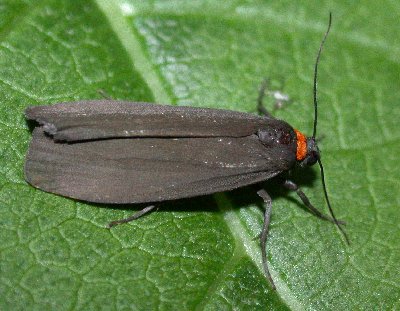
|
Ethmia
terminella ©
Matthew
Deans 2006
|
Red-necked Footman ©
Matthew
Deans 2006
|
A fantastic selection of macros were recorded - the most notable
including: Common Lutestring (12th), Blotched Emerald (23rd), Fern
(1st, 18th and 29th), Pretty Chalk Carpet (7th and 22nd), Haworth’s Pug
(12th, 23rd and 30th), Ash Pug (regularly recorded), Shaded Pug (30th),
Dingy Shell (two on 12th), Clay triple-lines (12th), Eyed
Hawk-moth (recorded five times throughout the month – first records),
Puss Moth (25th, fourth site record), Marbled Brown (7th and 23rd),
Red-necked Footman (11th - first site record), Orange Footman (good
count of six on 4th), Water Ermine (4th and 25th), Sand Dart (14th –
first site record), Lunar Yellow Underwing (13th), Common Quaker (late
specimen on 4th), Mathew’s Wainscot (regularly noted), L-album Wainscot
(four between 23rd and 30th), Obscure Wainscot (18th, 22nd and 23rd –
apparently the first County records since 1997), Flame Wainscot (11th
and 12th), Striped Wainscot (18th and 25th), Bird’s Wing (regular),
Double Lobed (25th and 30th), Large Nutmeg (three records), Small
Mottled Willow (30th - first site record), Bordered Straw (14th, 18th
and 19th – somewhat belated first site records), Silver Barred (13th –
first site record), Dark Spectacle (11th, 18th and 23rd) and
Pinion-streaked Snout (12th and 13th).

|

|
Sand Dart ©
Matthew
Deans 2006
|
Obscure Wainscot ©
Matthew
Deans 2006
|

|
Silver Barred ©
Matthew
Deans 2006
|
Regular migrant totals for the month were 235
Plutella xylostella (Diamond-back),
one
Ostrinia nubilalis
(European Corn-borer), one
Nomophila
noctuella (Rush Veneer), two Dark Sword-grass, one Small Mottled
Willow, three Bordered Straw and 30 Silver Y.
Mendlesham Green Records to 30th June
2006 - Steve Woolnough
As we all know only too well, the weather for the first half of the
year was unusually cold, and May unusually wet. Hardly surprising,
then, that this had a negative impacted on mothing.
I would usually start garden-trapping in mid-March, but this year the
trap received its first airing on 7th April; and even then only caught
two moths - a somewhat predictable Hebrew Character and Small Quaker. A
double-digit species count was achieved on 15th April, when a Twin-spot
Quaker and Early Grey occurred, but the remainder of the month was very
quiet, with the trap being run on only 6 nights and producing only 15
species, as against an April garden average of 22.
In terms of suitable weather for mothing, May was, if anything, worse,
and the trap only ran for four nights, during which just 38 species
were recorded, against a May average of 71. A peak species count of a
dismal 24 was achieved on 28th. A similar date last year produced 46.
The only notable event was an influx of Diamond-backed Moth early in
the month, with a peak count of 6 on 4th May.
The weather finally improved in June, and the trap was run on 12 nights
during which 139 species were recorded, which is in keeping with the
garden monthly average. There were four counts of over 50 species, with
the maximum being 79 on 30th, a record for the month.
The first new garden records for the year also occurred this month,
with a Small Elephant Hawk-moth on 16th finally making my garden
Suffolk hawk-moth collection complete (bar Death’s Head, which I hope
will be excused, but I wonder how many sites can claim both Convolvulus
and Striped before Small Elephant?). Other new garden records for June
were
Lathronympha strigana on
23rd and Triple-spotted Clay on 24th. The total of 79 recorded on 30th
included no fewer than three new records,
Metzneria lappella,
Ephestia parasitella, and Short
Cloaked Moth.
Other notable occurrences for June were the regular appearance of
White-point throughout the month. Possibly more evidence to show it is
now an established resident? Also, on 10th, A Lime Hawk-moth was
trapped with its right wings reversed - i.e. its hind-wing was above
and in front of its fore-wing. This unusual combination did not appear
to impede its flight in any way.

|
Lime Hawk-moth with 'reversed' right wings
©
Steve Woolnough 2006
|
The hot weather we are currently experiencing is now excellent for
moths (if not so attractive for sleep-deprived working moth-trappers),
and I am looking forward to 100+ counts for July.
Bungay - Spring to mid-Summer 2006 -
Records from Leigh Davis
Leigh Davis in Bungay reports the following species from his garden
actinic trap - Common Swift, Dipleurina lacustrata, Pyrausta aurata,
Eurrhypara hortulata, Small Fan-footed Wave, Garden Carpet, Barred
Yellow, Green Carpet, Green Pug, Brimstone Moth, Early Thorn, Waved
Umber, Mottled Beauty, Pale Tussock, White Ermine, Buff Ermine, Heart
and Dart, Flame, Flame Shoulder, Large Yellow Underwing, Small
Square-spot, Double Square-spot, Shears, Bright-line Brown-eye, Early
Grey, Angle Shades, Rustic Shoulder-knot, Tawny Marbled Minor,
Middle-barred Minor, Treble Lines, Uncertain, Burnished Brass, Silver
Y, Spectacle and Straw Dot.
Dunwich - April to June 2006 - Records
from Clive Moore
Clive Moore as well as spending a lot of time helping with the
recording of moths at Dunwich Heath NT has been running his home trap
on several occasions from April to June. Here are a selection of
the species he has recorded during that period - Frosted Green,
Brindled Beauty, Lesser Swallow Prominent, Powdered Quaker, Purple
Thorn,
Semioscopis steinkellneriana,
Great Prominent, Lunar Marbled Brown, Mullein, Red Chestnut, Scorched
Wing, Least Black Arches, Orange Footman, White-point,
Lobesia reliquana, Rivulet, Rustic
Shoulder-knot, Small Fan-foot, Shoulder-striped Wainscot,
Monopis monachella, Bird's Wing,
Broken-barred Carpet, Brown Rustic, Lychnis, Red-green Carpet, Barred
Yellow, Foxglove Pug, Grass Rivulet, Lobster Moth, Silver Barred, Small
Yellow Wave,
Prays fraxinella,
Schoenobius gigantella,
Epiblema foenella,
Anania verbascalis, Shaded
Fan-foot, Peacock, Sharp-angled Peacock,
Scoparia subfusca and
Olindia schumacherana.
Hollesley - January to June 2006 -
Records from Nick Mason
Nick Mason as well as running his trap in his garden has also been
visiting friend's gardens in the Hollesley area.
Species of interest from his garden include Ash Pug, Barred Red, Barred
Yellow, Beautiful Golden Y, Bird's Wing, Bordered White, Brindled
Beauty, Broad-barred White, Chocolate-tip, Cream-spot Tiger, Dark
Spectacle, Eyed Hawk-moth,
Pempelia
formosa, Grey Pug, Hummingbird Hawk-moth, L-album Wainscot,
Lead-coloured Drab, Lobster Moth, Maiden's Blush, Marbled Brown, May
Highflyer, Northern Drab,
Epiphyas
postvittana, Powdered Quaker, Puss Moth, Sharp-angled Peacock,
Small Clouded Brindle, Star-wort, Streamer, V-Pug, Toadflax Pug, White
Colon and White-point.
Species of interest from Nick's wanderings around Hollesley include
Barred Red, Bordered Straw, Ingrailed Clay, Lobster Moth, Marbled
Brown, Mathew's Wainscot, May Highflyer, Scorched Wing, White-point,
Brindled Beauty, Chocolate-tip, Cream-spot Tiger, Dingy Shell, Dotted
Border, Frosted Green, Great Prominent, Grey Pug, Lead-coloured Drab,
Lunar Marbled Brown, Oak Beauty, Orange Footman, Twin-spotted Quaker,
White Satin, Bird's Wing, Chamomile Shark, Dark Spectacle, Dark
Sword-grass, Dusky Brocade,
Ostrinia
nubilalis,
Lozotaenia
forsterana and Sharp-angled Peacock.
And finally from Shingle Street -
Ethmia
bipunctella, Bird's Wing, Cream-bordered Green Pea, Cream-spot
Tiger, Dark Spectacle, Dog's Tooth, Dusky Brocade, Latticed Heath,
Mullein Wave, Shaded Pug, Small Elephant Hawk-moth, Small Square-spot,
Rivulet, Water Ermine, White-point and White Colon.


